
Okay – let’s talk about AI.
I have a 10 part series that breaks down how I see the xAI issue – and my take on data centers and AI use. But this is not that – it’s coming – but this issue – the one I’m about to explain – in my opinion – is a much bigger deal.
I think the more pressing danger is that almost everyone with a retirement account is about to be heavily invested in AI – which is quite the conundrum if you’re anti-AI.
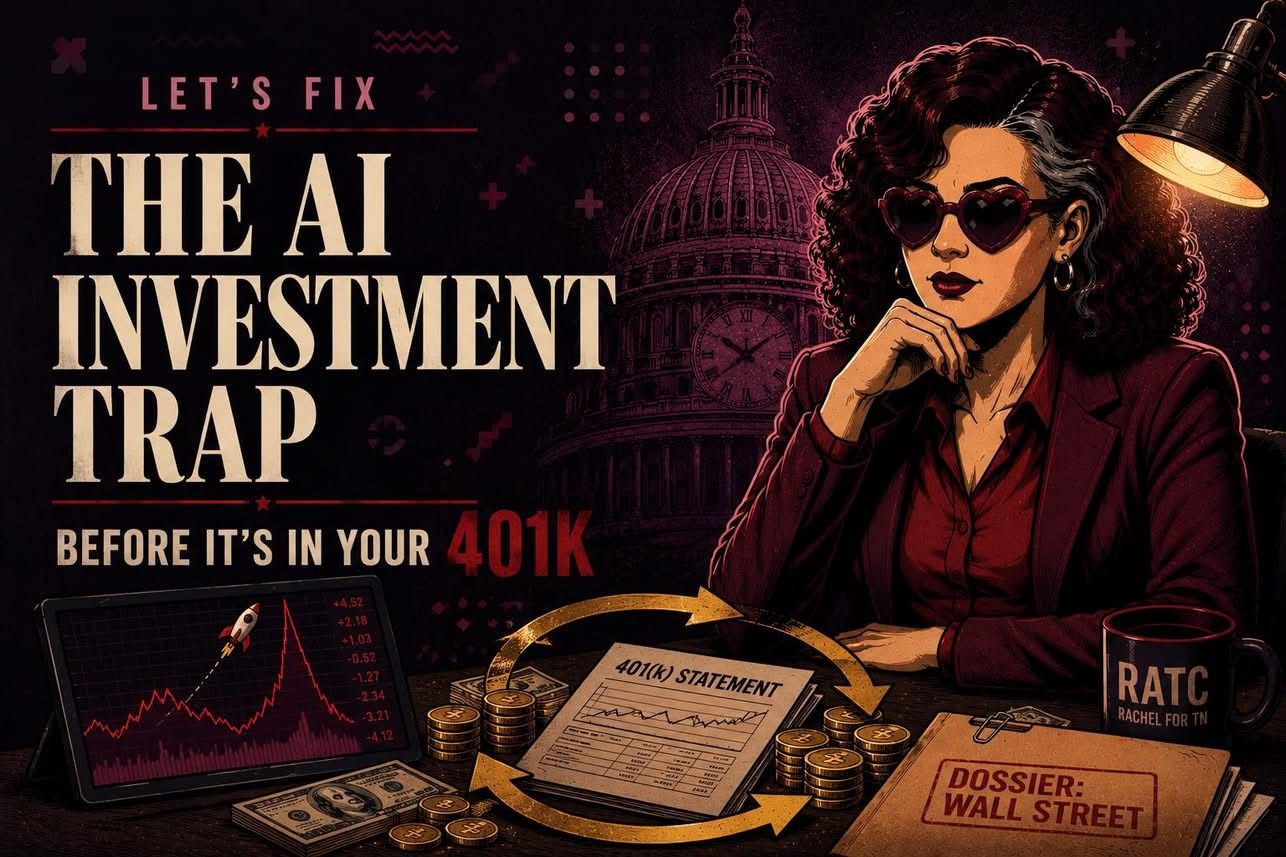
I’ve written about the fact that the AI boom is being funded in a circle several times – but if you’re new here – it works like this.
Nvidia makes the chips everyone needs. Nvidia takes some of its money and invests it in the big AI companies, like OpenAI and Elon Musk’s xAI.
Those companies turn around and spend that same money buying Nvidia’s chips and renting data centers from companies like Oracle. And those data center companies use the money to buy, you guessed it, more Nvidia chips. The cash goes out one door and comes back in another. The same dollars getting passed around in a circle.
This isn’t a fringe theory. Morgan Stanley drew the map of it. Analysts in 2026 put the web of these deals north of 800 billion dollars. Even the people defending it don’t deny the shape, they just call it a “virtuous circle” instead of a closed loop.
So, why does this matter?
Because it manufactures the appearance of demand. When Nvidia funds a company that then “buys” from Nvidia, Nvidia gets to report that as a sale. It looks like the world is desperate for this product. But a chunk of that demand isn’t the world. It’s the same small group of companies passing the same money back and forth and booking it as revenue each time it changes hands.
Strip out the money they’re handing each other and the real question is how many actual customers, outside the circle, are paying real money for this. Nobody can answer that right now. And that’s a problem.
So you’ve got a handful of companies, most of them losing staggering amounts of money, valued at numbers that have never existed before, holding each other up by buying from each other. If the demand turns out to be smaller than the hype, the whole circle deflates at once.
And here’s the part that makes this bigger than a few tech stocks.
This spending is holding up the whole economy right now. In the first half of 2025, the money pouring into AI and the data centers behind it added more to our economic growth than all consumer spending combined. Strip it out and the picture gets grim fast. The chief strategist at one research firm, BCA, put it bluntly: without the AI boom, it’s plausible the economy would already be in a recession. So this isn’t only about whether some overpriced stocks fall. It’s that the thing holding up the entire economy is a circle of companies betting on each other, and if the bet goes bad, it doesn’t stay contained to them.
Now, normally, you could shrug and say that’s rich people’s poker. If a bunch of overpriced tech companies want to gamble on each other, let them lose their own money.
Except it’s not going to be their money. It’s going to be yours. And here’s why.
Most people’s retirement savings sit in index funds. A 401k, an IRA, or a pension. An index fund doesn’t pick stocks. It buys whatever is on a list, the S&P 500 or the Nasdaq 100, and when a company gets added to that list, every fund tracking that list has to go buy it. Not because anyone decided it was a smart buy. Because the fund’s own rules say so. Your retirement money does what the list tells it to do.
For decades there was a guardrail on that. When a company went public, the big indexes made it trade for months, sometimes a full year, before it could join the list. The point was to let the market settle on an honest price before trillions in retirement money got pointed at it. They called it a seasoning period.
This spring, Nasdaq scrapped it. As of May 1, a company big enough only has to trade for 15 days before it can be fast-tracked onto the Nasdaq 100. They also gutted the rule that made sure enough of a company’s shares were actually available to trade before it got added. The S&P 500 is now considering its own version, cutting its waiting period in half. Goldman Sachs estimated the change could force up to 60 billion dollars in automatic buying.
So – let’s imagine how this could play out.
SpaceX is reportedly set to go public on June 12, the same Elon Musk company that swallowed his money-losing AI venture, at a valuation of one and three-quarter trillion dollars.
That’s the biggest IPO in history, by far.
The deal is built to spike. They’re floating only a tiny sliver of the company, under 5 percent, and steering an unusually huge share, up to 30 percent, straight at small investors instead of the professionals whose job is to question the price. That’s not how it usually works. Usually a much larger share is reserved for the professional buyers – but they’re teeing this up for the fanboys.
Fifteen days after that, under the new rule, it can land on the index. And every fund tracking that index, including the one in your 401k, is forced to buy it at that jacked-up price. And SpaceX structured unusually early sell windows for insiders, well before the typical lockup most companies hold to.
So all of the folks on the inside, the ones that work for these companies and were given shares as part of their compensation, the ones that know these numbers are highly inflated – they’re very likely to cash out.
So – line it up. The price gets pumped. Your retirement fund is forced in at the top. The early money cashes out into the buying. And who gets stuck holding the bag?
And SpaceX is just the first one through the door. OpenAI and Anthropic are lining up behind it, same playbook, same fast-track. We’re about to march a row of these companies, the exact ones propping each other up in that circle, straight onto the lists that your retirement savings are mechanically required to track.
This is not a red or blue thing, and nobody you voted for did it.
The stock exchanges are private, for-profit companies. They wrote this rule themselves, after Musk’s people reportedly asked them to speed things up, and Nasdaq, which competes with the New York Stock Exchange for big listings, said yes.
Index rule changes don’t need approval from the SEC, the agency that’s supposed to be the cop here. The single biggest change to what your retirement is forced to buy happened with no government sign-off at all. It just took effect.
You want to know who’s already nervous?
Warren Buffett’s company is sitting on a record pile of cash, almost 400 billion dollars, and has been selling more stock than it buys for 14 quarters in a row. Buffett said at this year’s meeting he’s never seen people in more of a gambling mood. When the most patient money on earth is backing away from the table, that’s not nothing.
Here’s why this matters for District 5.
There’s a teacher in Frayser with a pension. A line worker in Dyersburg with a 401k. A small business owner in Maury County with a retirement account she’s been feeding for twenty years. Not one of them bought SpaceX. Not one of them was asked whether their savings should bankroll a trillion-dollar bet on AI companies that don’t turn a profit. But the rule says their index fund has to buy, so it buys.
This is one issue that should unite everyone in District 5 – their retirement money is being quietly volunteered for the same gamble, and the people running it don’t think they owe anybody a heads up.
So what can a member of Congress actually do?
I’ll give you the limits first, like I always will. A member of Congress cannot walk into Nasdaq and rewrite a private company’s rulebook. That lever isn’t federal. But two things are.
One: close the blind spot. These index changes currently happen with zero review. You could require that any index rule change big enough to force buying inside Americans’ retirement accounts gets checked by the SEC before it takes effect, not after the money’s already gone in.
Two: protect the saver directly. Write a floor into law. If a stock is going to be mechanically force-bought by the index funds in people’s 401ks, it has to clear a real waiting period and have enough shares actually trading first, so there’s an honest price before retirement money gets aimed at it. Put the guardrail back, this time somewhere a for-profit exchange can’t delete it because a billionaire asked.
AI companies and data centers need regulation. Full stop. But that’s a battle that’s been fought before and there’s a clear path. We’ve been here before. The same issues came up when power grids started being built in this country. It’s going to take thought and planning – but we’ll get there.
I often point out the irony of people being anti-AI while using this or any other social media app. Facebook is one of the biggest AI companies on the planet. AI is being used to serve you this post.
But what a wicked web – that soon people will be automatically invested in AI, and there will still be people cheering on its failure, when its failure would be a catastrophic financial event.
There is NO easy answer to any of this. It’s way too late for a simple way out.
But I believe that we need people in Congress that actually understand the complexity of these issues – not someone who is going to promise you there’s an easy solution.