I’ve been looking for more solutions that address affordability – you know, that word Trump said Democrats made up?
Last week, I wrote about ethanol – how a 1970s rule still forces corn into your gas tank and quietly raises what you pay. Well, sugar works the same way.
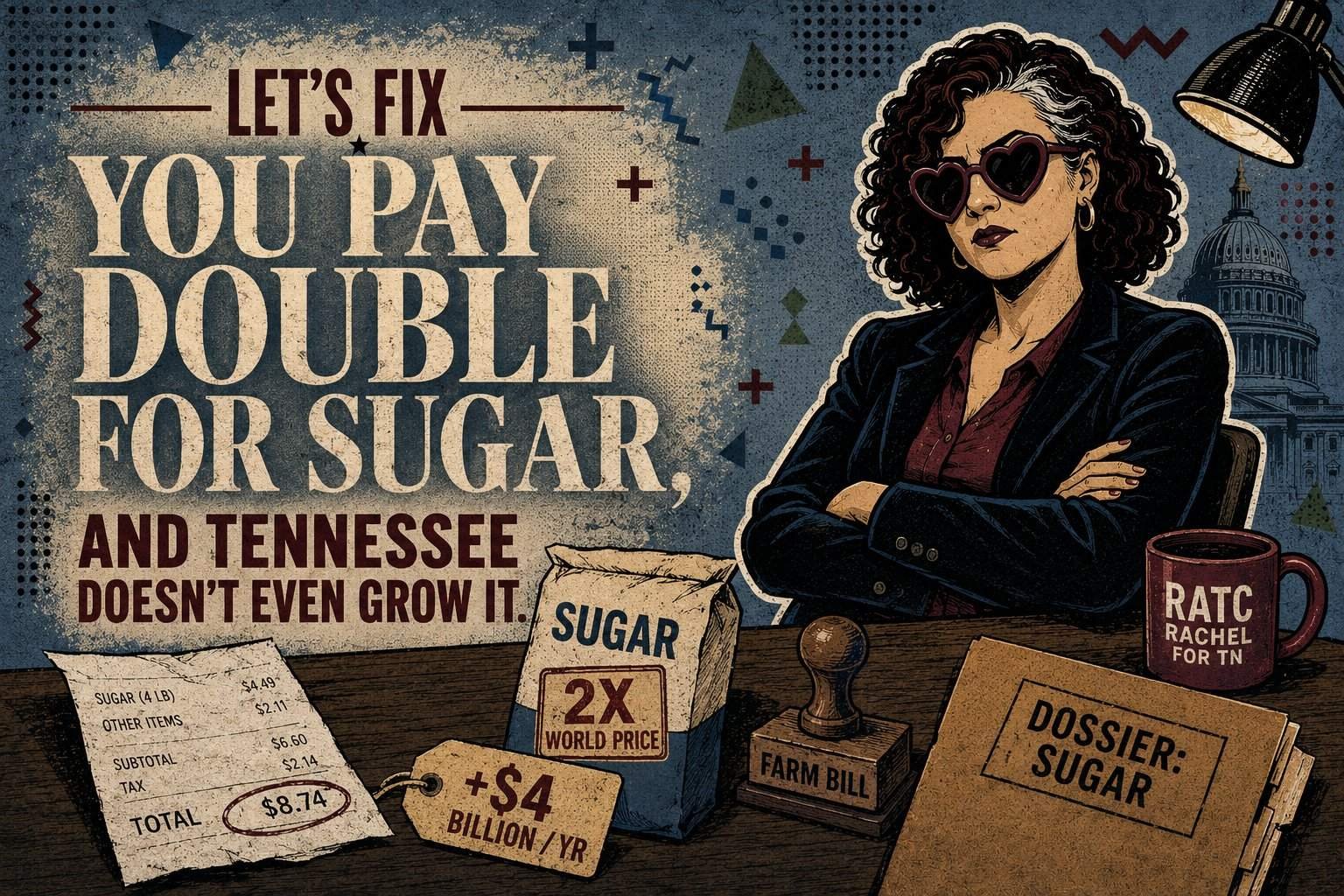
The federal government caps how much sugar can come into the country and puts a high tax on anything over the line – about 15 cents a pound, versus less than a penny under it. It also limits how much American producers can sell. Less sugar on the market, higher price. It’s government-backed price support, built to keep sugar prices above world levels.
So we pay close to double the world price for sugar. Not a little more. Double. Some studies put the hit to shoppers at $2.4 to $4 billion a year. You don’t pay that extra cost just when you buy a bag of sugar – you pay it inside bread, cereal, soda, candy, and ketchup. It’s a tax you can’t see, spread across your whole cart.
And here’s what stings for us: Tennessee isn’t a sugar state. No cane industry, no beet industry. The program props up farms in Louisiana, Florida, and a handful of northern beet states, while every family in West Tennessee pays the higher price and gets nothing back.
Not to mention, Americans eat a ton of sugar – about 17 teaspoons of added sugar a day, close to triple what doctors say is healthy. So we’re paying extra for a product we already get way too much of.
Some people have tried sugar taxes to limit consumption – but if we actually wanted people to eat less, there are cheap ways to do it that don’t cost shoppers a dime. Chile put a black “high in sugar” warning right on the front of the package, stopped sugary ads aimed at kids, and pulled sugary drinks from school vending machines. Sugary-drink purchases dropped somewhere around 20 to 25 percent, and companies cut the sugar in their products just to lose the warning label. No price hike. Mexico and other countries have done versions of the same.
We don’t do much of that here. We don’t warn you on the front of the box. What we do instead is prop the price up to protect the people who grow it. So we get the worst deal going: we pay more than the rest of the world for sugar, and we still take in far more added sugar than doctors say is good for us.
The price supports go back to the 1930s and were locked in with the 1981 farm bill. The first idea was to keep American sugar farmers from getting wiped out by cheap foreign sugar. Fine. That was the reason then. But the rule never goes away. While other farm programs have changed a lot over the decades, sugar has stayed one of the most protected programs in the whole farm bill.
And it’s not that nobody’s tried. The Fair Sugar Policy Act has been written up in almost every Congress since 2011, with Republicans and Democrats both signing on. It dies every single time.
Why? By one tally, the sugar industry gave politicians more than $40 million from 1990 to 2016, and it gives to both parties on purpose. One sugar cooperative reported putting up more than $3 million in the last election cycle alone. That’s the whole game – a small group spends big to keep a sweet deal, and a bill that should be easy never makes it out alive.
To be fair, there’s a real case for growing some sugar at home, so we’re not fully dependent on other countries for food. That part makes sense. But “grow some at home” and “shoppers pay double forever so a few stay rich” are not the same thing.
So what can one House member actually do? The sugar program lives in the farm bill, which Congress rewrites every few years – a federal vote, not a state one. Vote to put the fix back in. Sign on to the Fair Sugar Policy Act. Push the FDA for clear front-of-package labels. And refuse the industry money that keeps everyone else quiet.
It’s the same setup every time. A rule that made sense once, a small group that cashes in on it now, and a bill that lands on the rest of us where we never think to look.
Sources
- GAO, Sugar Program (GAO-24-106144)
- USDA ERS, Sugar and Sweeteners Policy
- AEI / Yeutter Institute, effects of the US sugar program
- UNC Gillings, Chile front-of-package warning label evaluation
- ProMarket / Center for Responsive Politics, sugar industry political spending
- OpenSecrets, American Crystal Sugar 2024 cycle
- Trump remarks on affordability, Chippewa Falls WI (June 5, 2026)