
I’ve lived in “alternative” housing for five years now. So this one’s personal.
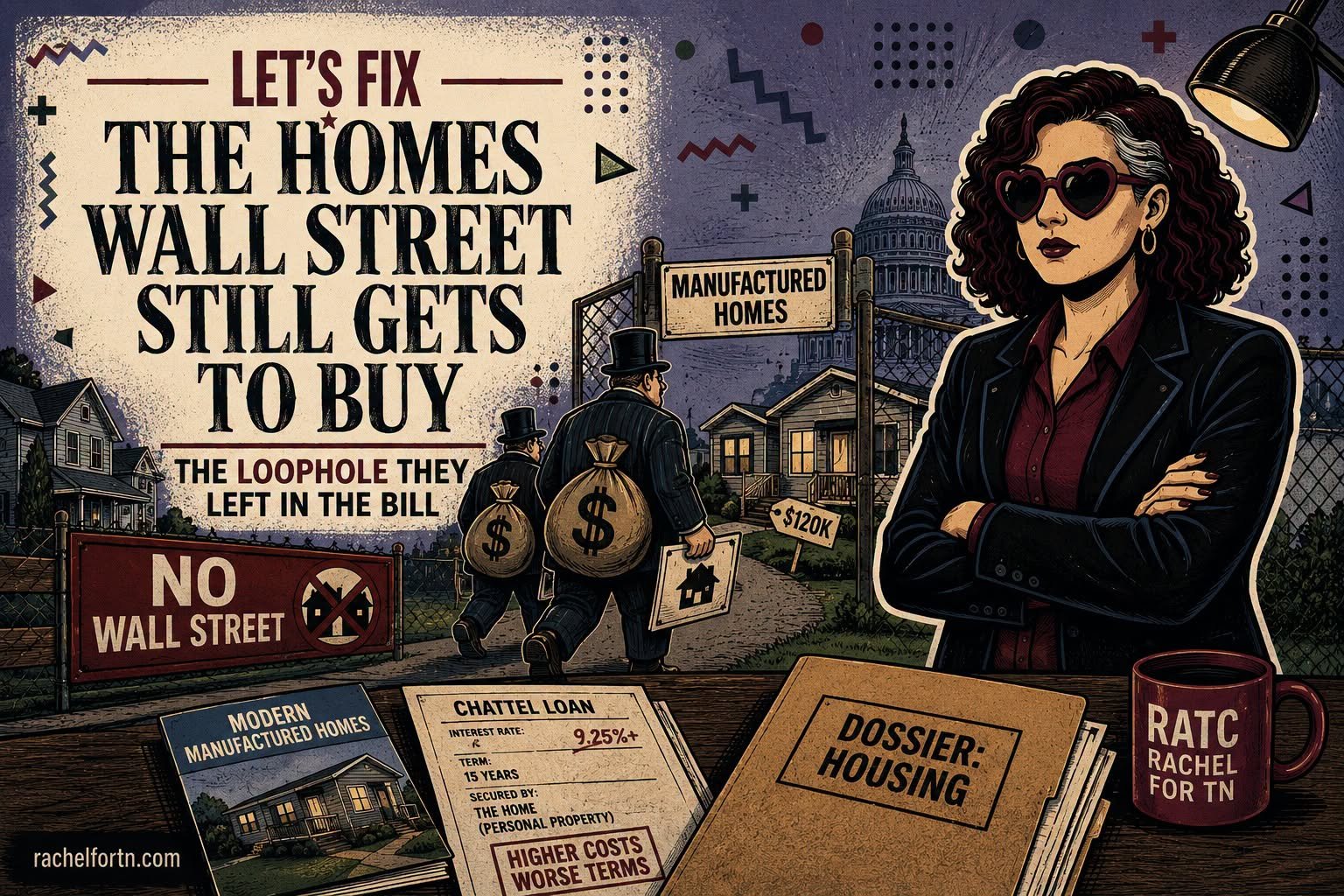
Congress is on the verge of passing what people are calling the biggest housing bill in decades. It clamps down on Wall Street buying up single-family homes. Then, right there in the definition, it carves out an exception: manufactured homes don’t count.
So? Big investors can keep buying those by the truckload. The bill that’s supposed to stop corporate landlords leaves the door wide open on some of the most affordable housing there is.
Now – you might picture a manufactured home as the thing you park in a trailer lot, with all the baggage that word carries.
But today’s modular homes are nothing like the old stereotype. If you haven’t seen the new models, you should – they look like regular houses, they’ve got the latest tech, and they run about half the cost of building traditional. They’re seriously cool.
Let me back up and start with the bill.
It’s called the 21st Century ROAD to Housing Act. Tim Scott, a Republican, and Elizabeth Warren, a Democrat, drove it. The House passed it 390 to 9. The Senate passed it 89 to 10. It’s in the final round now where the two sides settle their differences, and it’ll probably land on the president’s desk.
Credit where it’s due – a real bipartisan housing bill is rare, and parts of this one matter. It restricts big private equity firms from buying up more single-family houses. It cuts some red tape. It nods at modern manufactured housing instead of treating it like a trailer joke.
That nod is where I want to stop you.
Manufactured homes are a major source of affordable housing across much of this district – what folks still call mobile homes, even though one built in a factory today, installed and kept up right, can last as long as a house built on a lot. It’s the most affordable path to actually owning something. And the federal government has spent decades quietly making it harder than it has to be.
Two things break it, and this bill touches neither.
First, the loan. When you buy most manufactured homes, you don’t get a regular mortgage. You get what’s called a chattel loan – the home counts as personal property, like a car, not real estate. About 70 percent of manufactured-home buyers are stuck with these.
They cost more, the terms are worse, and you build less. Fannie Mae and Freddie Mac – the federal mortgage giants – were told by law years ago to start backing these loans so the rates would come down. They’ve dragged their feet ever since. The bill doesn’t make them do it.
Second, the zoning. A 2000 federal law gives HUD authority that a lot of housing advocates say should stop towns from flat-out banning homes built to the federal code. In practice, towns do it anyway, and Washington doesn’t push back. So a family can buy an affordable home they can’t legally put anywhere. The bill leaves that alone too.
Here’s who that suits just fine. A handful of big companies build most manufactured homes and own most of the land-lease parks. When zoning blocks new competition and bad loans keep buyers locked in, those companies win. Fewer rivals, captive customers. The squeeze on you is the moat around them. That’s not an accident in the bill. It’s what got left out of it.
And it’s both parties leaving it out. Warren’s name is on this. So is Scott’s. The investor exemption, the financing they skipped, the zoning they ducked – that’s a bipartisan blind spot, and the people who profit from it fund campaigns in both directions.
So what can one House member actually do?
Not rewrite federal housing law alone – that takes the whole House, sixty votes in the Senate, a signature. I won’t pretend otherwise. But the levers are real.
I can cosponsor the fix that forces Fannie and Freddie to back manufactured-home loans for real, not on paper. Push HUD to enforce the rule that’s been sitting on the books since 2000. Close the investor exemption so the same protection covers the homes people out here actually buy.
There’s a smaller one happening right now too. The USDA is changing its rural loan rules to let people finance a backyard cottage – an ADU, an extra small unit on your lot you can rent out or put an aging parent in. The kind of thing that lets somebody stay on their land and bring in a little income.
A member of Congress should be watchdogging rules like that to make sure they actually reach rural Tennessee instead of dying in the fine print.
The big housing bill is going to pass and everybody’s going to take a victory lap. I’d rather tell you what it forgot. The homes most of this district lives in got a pat on the head and a loophole.
That’s the part I’d be fighting to fix.
Sources
- The Hill – Congress nears passage of the 21st Century ROAD to Housing Act
- Latham & Watkins – Title IX exempts manufactured homes from the institutional-investor restrictions
- Bipartisan Policy Center – What’s in the 21st Century ROAD to Housing Act
- U.S. Senate Banking Committee – Senate passes the ROAD to Housing Act, 89–10
- MHARR – the chattel-financing and zoning bottlenecks (about 70% chattel, Duty to Serve, the 2000 enhanced-preemption authority)
- Federal Reserve, 2024 Survey of Consumer Finances – average manufactured-home chattel rate 8.69% vs. 6.81% for a traditional mortgage
- Federal Register – USDA Rural Housing Service proposed rule on financing income-producing ADUs (docket RHS-26-SFH-0100)
- HUD Office of Manufactured Housing Programs – proposed rule revising the definition of a manufactured home