
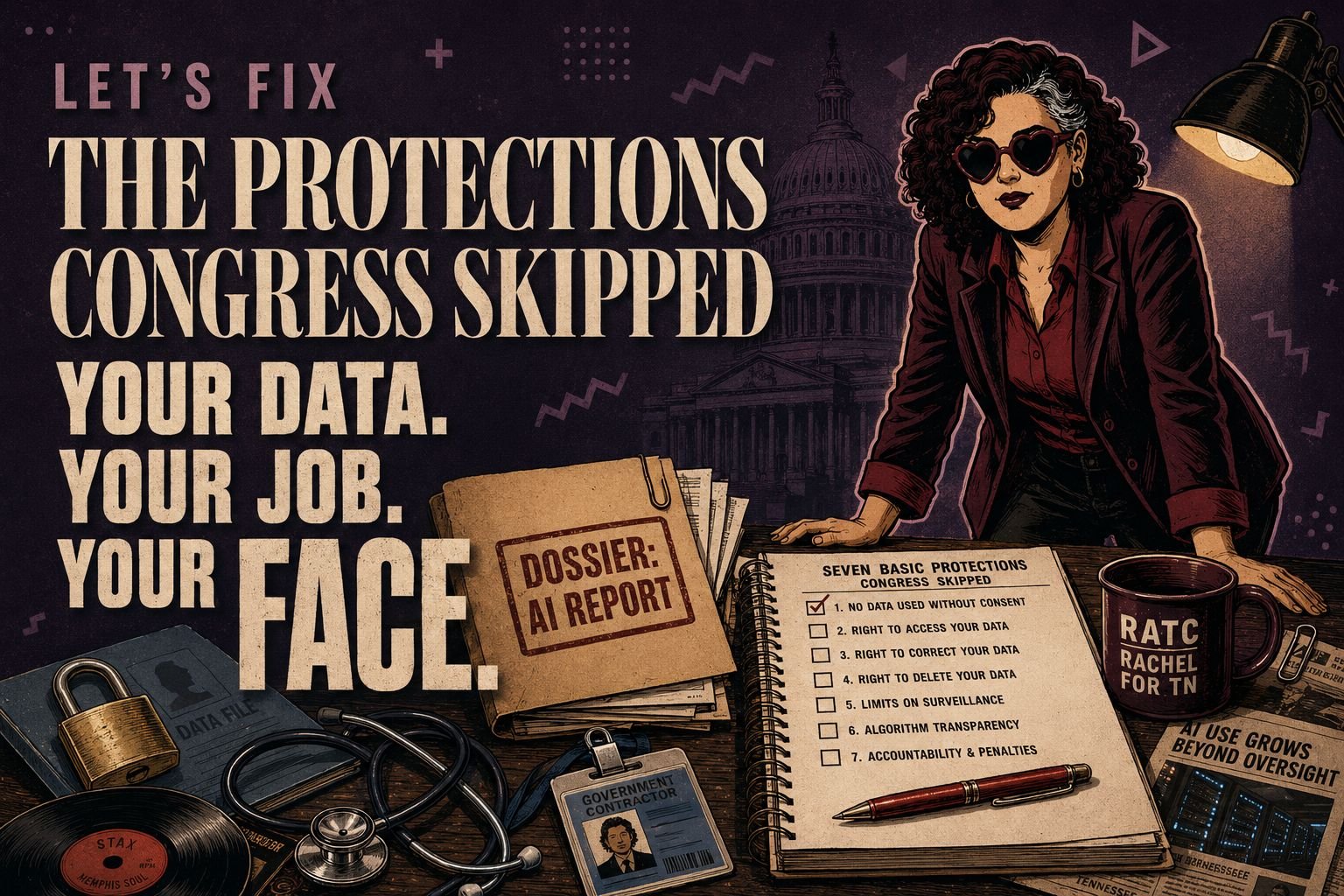
This morning I told you how the House built a bipartisan AI task force and then dissolved it the day the report dropped. I’ve been reading the report – this is what I found.
A lot of the 85 items in the report are about helping the government and industry use more AI – adoption, research funding, military uses, and standards.
But buried in the report is a shorter list – the recommendations about protecting people from what AI is already doing to them. Those are the ones that matter at your kitchen table, and those are the ones Congress still hasn’t acted on.
1. Your data
The report says AI systems collect huge amounts of your data and “Americans have limited recourse” when it gets misused. When a company scrapes your info to train an AI, you often have very little legal recourse.
Their fix: a general federal privacy law covering all technology.
2. Your rights
The report warns that AI is already making big calls about people – loans, benefits, hiring – and that flawed AI decisions can “deprive Americans of our most important rights.” If a computer helped deny your claim, you deserve to know a computer was involved.
Their fix: keep a human in the loop on the big decisions, and require safeguards against discriminatory AI.
3. The government using AI on you
Separate from companies – the report says federal agencies are already using AI in their own programs, and that the government should be wary of letting algorithms drive decisions.
Their fix: require agencies to tell you when AI played a role in a government decision about you.
4. Your job
The report says AI is colliding with labor laws and worker protections, and that retraining hasn’t kept up with how fast jobs are changing.
Their fix: monitor how AI interacts with worker protections, and build real retraining paths for the people it displaces.
5. Your healthcare
The report says AI is already reading scans and shaping treatment, and that liability rules need to be clarified as AI gets more involved in medical care – so it’s clear who’s responsible when it screws up.
Their fix: safety and transparency standards for AI used on patients, and clear liability rules.
6. Your work being used for training
The report admits creators often can’t even find out if their writing, music, or art is being used to train AI models, and the courts are sorting it out one lawsuit at a time. Memphis and Nashville run on people who make things for a living, so this one lands hard here.
Their fix: Congress should clarify the law instead of leaving artists to fight trillion-dollar companies in court.
7. Your face and your voice
The report called for real tools to protect victims of AI-generated fakes. This is the one area that became law – victims of deepfake porn can now force the images off the internet. It’s a good law, and it passed because both parties felt the pressure to do something.
So on the part of the report that’s about protecting you – your data, your rights, your job, your healthcare, your work, your face – the score is 1 for 7.
The adoption side of the ledger is moving on its own. The industry is building as fast as it can with or without Congress. The protection side only exists if Congress writes it – and Congress hasn’t.
Even the mild stuff sat there.
The report’s one line on whether the feds should override state AI laws said study it first. Congress skipped the study and went straight to the fight – twice tried to block states from enforcing their own AI laws through must-pass bills, lost both times, and the White House is now trying it by executive order.
Sen. Josh Hawley – a Republican – said the quiet part out loud this year: the AI money is almost all the same people as the social media money, they’re hugely influential, and they don’t want anything done. On that score, Congress delivered exactly what was paid for.
So here’s what I’d push for…
First, the transparency bills – the ones that cost nothing and no honest person opposes. A right to know when AI made a decision about you. A right for creators to know when their work trains a model.
But knowing isn’t enough on its own. Reporters have already caught these companies training on stolen books and scraped articles. And when an artist finds out, their only real option right now is to lawyer up against a trillion-dollar company and hope a court sorts it out in five years. Nobody can afford that. So disclosure has to come with legislation – if a company wants to train on your work, it needs your permission first, and you should get paid for it.
Second, I would push for the privacy law. Congress has failed for years to pass one, because the companies profiting from your data fund the people voting on it – which is exactly why I don’t take corporate PAC money.
And third, the thing I said this morning: make the task force permanent.
This report was written in 2024, and it’s already behind. AI is being wired into new corners of your life daily – your insurance, your job application, your kid’s classroom, your power grid – and every new use creates a new way for it to affect you.
A report every couple of years can’t keep up with a technology that changes every week. Congress needs a standing body whose whole job is watching this thing and stopping the harms before they land on you.