
Let’s talk about crime prevention, because it’s the question I get asked most in Memphis, and the honest answer starts with what a freshman member of Congress can and can’t do.
Here’s the thing – a first-term representative doesn’t walk in and pass landmark legislation. Seniority runs the committees, leadership runs the floor, and a freshman bill mostly dies in a drawer. No one in my race is going to be able to do anything revolutionary on this issue.
But the good news is we don’t have to.
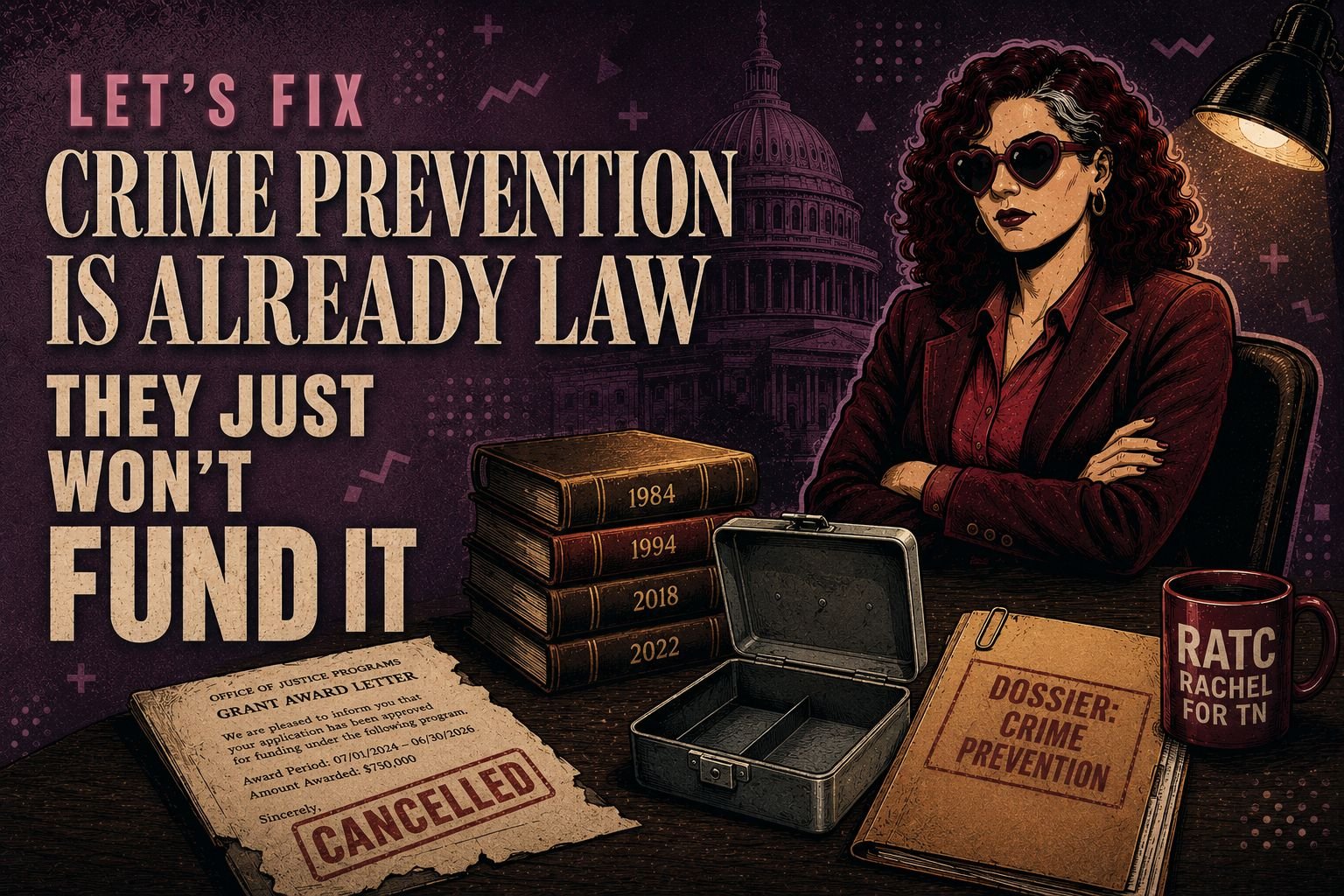
We don’t have a legislation problem. We have a funding problem. The laws already exist. Congress already did the hard part. Both parties have already agreed on what works. The current administration just won’t send the money.
Here’s what has already passed.
The Bipartisan Safer Communities Act passed in 2022 with Republican votes. It funds community violence intervention – trained outreach workers who stop the retaliation shooting before it happens. Some of these programs have reported reductions in shootings approaching 60% in the neighborhoods they cover, and a Johns Hopkins study found every $1 invested returns about $7 to $19.
In April 2025, the DOJ canceled roughly $150 million of it by memo – part of $811 million in public safety grants killed mid-cycle across more than 550 organizations. One of them was Heal 901, the group doing this exact work in Memphis. But the law they defunded is still on the books.
Then there’s the Victims of Crime Act, which has been law since 1984. It pays for crisis counseling, shelters, and victim compensation in all 50 states. Last year, the DOJ threatened to withhold nearly $1.4 billion of it unless states complied with unrelated immigration demands. A coalition of 21 attorneys general had to sue to shake loose money the law already guarantees.
The Violence Against Women Act has been law since 1994. Its grant applications were delayed for months in 2025, a federal judge had to block the administration from attaching ideological conditions to the funds, and the president’s budget proposed cutting its programs by more than $200 million. But it’s still the law.
The STOP School Violence Act passed after Parkland and was signed by Trump himself – some of those grants got cut mid-cycle too. The law still exists.
So how do they withhold money Congress already approved?
There’s a playbook. Cancel grants mid-cycle with a boilerplate clause saying the work “no longer effectuates” the administration’s priorities – that’s the $811 million. Attach new strings to money the law guarantees – that’s the $1.4 billion victims’ fund fight. Or never post the application forms, so the money sits unspent and there’s nothing to sue over – that’s the domestic violence grants.
There’s even a law about this. The Impoundment Control Act of 1974 sharply limits a president’s ability to withhold money Congress has appropriated. That’s why judges keep ruling these moves unlawful – one called the grant cuts arbitrary and said no agency, least of all the Justice Department, should conduct itself that way.
But here’s the part that should bother you most. Even where the courts ruled against them, the money still didn’t move. That same judge admitted he lacked the power to reverse the cuts. Organizations that appealed got silence. A ruling doesn’t write the check. Congress writes the check.
Notice what they never do. They never repeal these laws, because the laws are popular and the repeal votes would be ugly. They stop sending the money and bet you won’t notice. The law stays on the books like a storefront with nothing behind the window.
So how does Congress actually turn the money back on? Three ways, and they all run through the House.
First, appropriations. Every year, Congress writes the DOJ’s budget line by line. The House can write “shall” instead of “may” – money that must go out, with dollar amounts, deadlines to post the application forms, and language banning the strings. An administration can slow-walk a vague appropriation. It can’t slow-walk a bill that says fund this program, this amount, by this date.
Second, oversight. The House can subpoena the officials who canceled these grants and make them explain it under oath.
Third – and this is the honest part – none of that happens under the current House majority, because the majority sets the committee gavels and writes the first draft of every spending bill. The Republicans running the House have watched all of this and done nothing. So when I say the fix is funding the laws we already passed, I’m telling you plainly what that requires: a House majority willing to write it in, and members in the room who’ve done the homework. That’s the seat I’m running for, and this is the homework.
The agreement already happened. Congress voted. Presidents signed. The only thing missing is the money – and the money starts in the House, every single year.
Sources
- DOJ Funding Update: A Deeper Look at the Cuts (Council on Criminal Justice)
- Memphis violence intervention group fights for funding after federal grant cut (WREG)
- Democratic AGs sue DOJ to receive federal funding for victims of violent crimes (Stateline)
- Without the federal government, almost no money exists to fight domestic violence (The 19th)
- Crime-Prevention Efforts Face Setbacks After Federal Cuts (Brennan Center)
- Federal Cuts Are Weakening Lifelines for Survivors of Violence (Giffords)
- Public safety groups face an uncertain future months after federal grant cuts (NPR)