
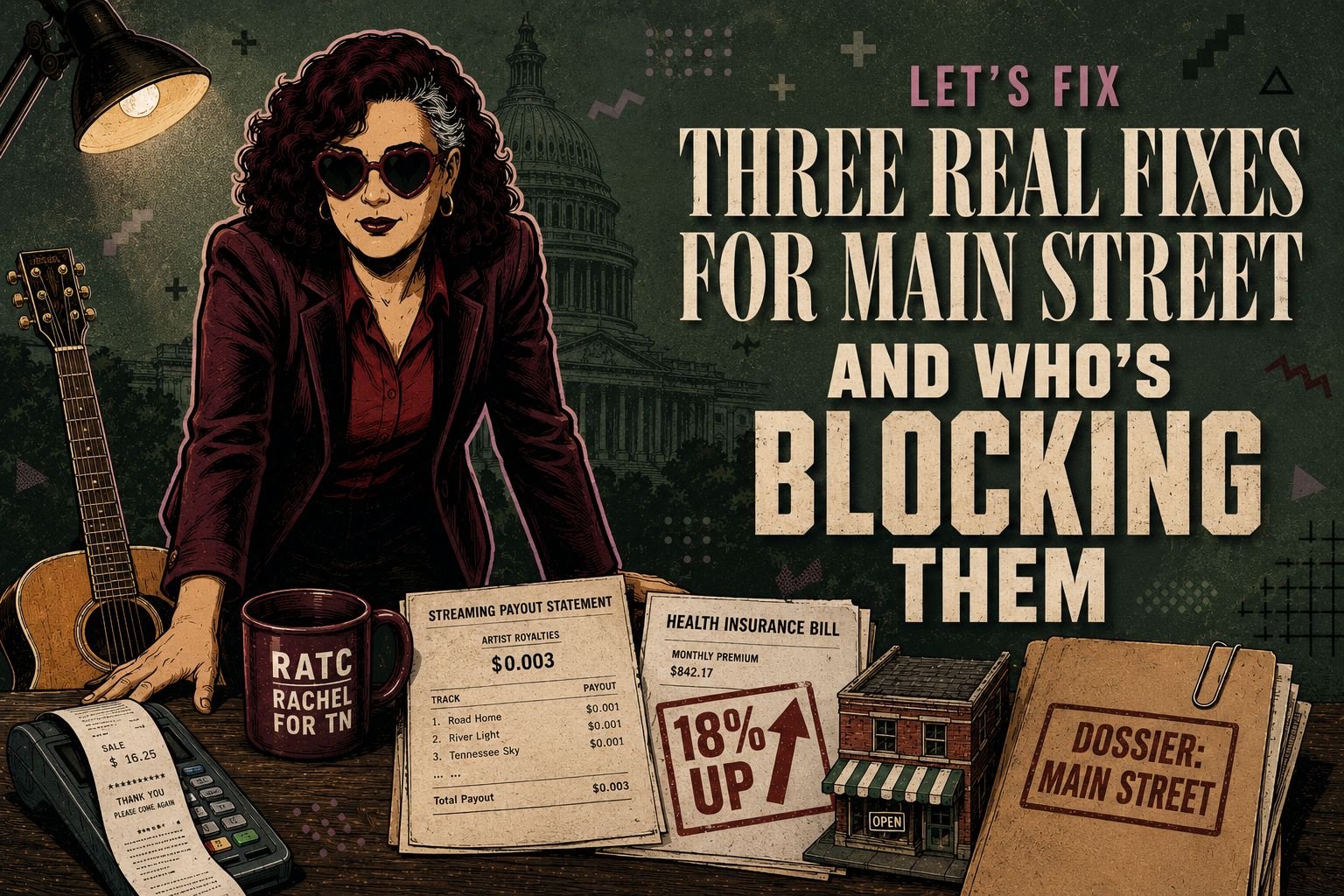
Let’s talk about small businesses, because everybody running for office says they love Main Street, and almost nobody names one thing Congress could actually do for it. I’ll name three.
The first one is swipe fees.
Every time a customer taps a card, the card company and the bank take a cut of the sale – about 2% to 4% of every sale. On a $5 coffee, that’s 10 to 20 cents gone before the shop owner sees a dime. It sounds tiny until you add it up. The National Retail Federation says businesses paid $198 billion in swipe fees last year. That’s a record, and it’s up 80% since the pandemic. For many shops, it’s one of the biggest bills they pay after payroll.
And the owner can’t shop around for a better rate, because there’s nowhere to shop. Visa and Mastercard control more than 80% of the market, and they largely set the fee schedules and rules used by the banks that issue their cards. Small businesses have very little leverage to negotiate a better deal. And you can’t run a business in 2026 without taking cards.
The fix already exists.
It’s called the Credit Card Competition Act. Durbin, a Democrat, and Marshall, a Republican, wrote it. It says the biggest banks have to put a second payment network on each card, so businesses can send the sale to whichever one charges less. That’s it. No price caps. Just competition. Supporters say it would save about $15 billion a year. Even Trump criticized swipe fees as out of control and supported more competition in the payments market.
So why isn’t it law?
It has died without a vote in three straight Congresses while the banks and card issuers that profit from the current system lobbied against it. Both parties take the banks’ money. You can draw your own conclusion about why it never gets a vote.
The second one is musicians.
I spent 30 years in the music business, so hear me on this – a working musician is a small business. One person, self-employed, selling a product. And Memphis and Nashville were built by them.
Here’s what most people don’t know. Workers with a boss can join a union and bargain together. Independent musicians can’t, because the law calls them contractors, not workers. So the laws written to stop corporate price-fixing get pointed at musicians instead. If artists team up to ask Spotify for better pay, they could face antitrust liability – treated like an illegal cartel. The people who built the sound this city sells to tourists can’t legally join together to ask for more than $0.003 a stream. That’s a third of a penny.
There’s a bill for this too.
It’s called the Protect Working Musicians Act, and it came back to Congress in May. It lets independent artists making under $1 million a year team up and negotiate with the big streaming platforms – and with the AI companies training on their music. Right now that’s being done to them, not with them.
Memphis’s own Steve Cohen already signed on, and big music groups back it, from the Recording Academy to the songwriter guilds. I watched three decades of talented people quit this business because the math stopped working. This bill is the first honest try at fixing the math. A representative from the home of American music should be loud about it.
The third one is health insurance – the quiet killer.
Many small businesses – especially the smallest ones – don’t offer health insurance at all. This year, insurers requested premium increases around 11% in many small-group markets and around 18% on the marketplace, which is where most self-employed people buy their own coverage. That includes every working musician I just described.
When a one-person business gets an 18% jump, that’s the money that would’ve hired the first employee. Congress writes the rules for that marketplace and decides the help people get paying for it. I’d vote to make coverage cheaper every time. And I won’t pretend cheap, stripped-down plans that leave you holding the bag when you get sick are a real fix.
Now here’s the honest part.
Some of what squeezes small businesses here isn’t federal at all. Licensing rules are mostly state law. Permits are city and county. A member of Congress who promises to fix those is lying to you. What the seat actually controls is what I named – the card fees, the law aimed at the wrong target, and the insurance rules.
And when the bank lobby shows up to kill the swipe fee bill a fourth time, the only question that matters is whether the member owes them anything. I don’t take PAC money. Not from banks, not from streaming platforms, not from anyone. Main Street competes for every customer, every day. The companies feeding off it should have to compete too.
Sources
- Pass the Credit Card Competition Act (National Retail Federation)
- Durbin, Marshall Reintroduce The Credit Card Competition Act (Sen. Durbin)
- ‘Protect Working Musicians Act’ Reintroduced in Congress (Digital Music News)
- Ross Introduces Legislation to Support Independent Musicians (Rep. Deborah Ross)
- NFIB to Congress: Advance Small Business Priorities in 2026 (NFIB)
- 2026 SBAC State and Federal Advocacy Agenda (Small Business Advocacy Council)