
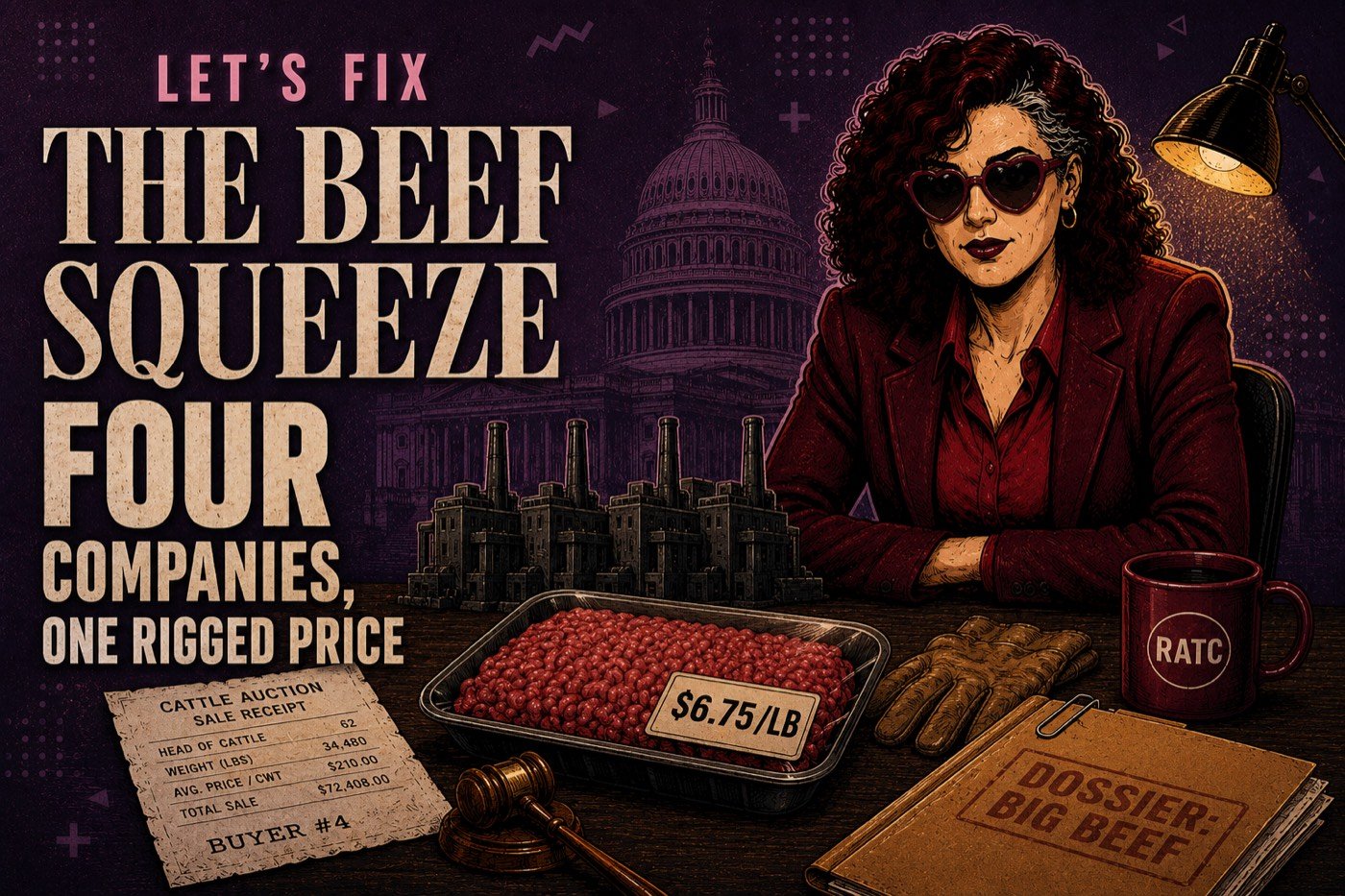
It used to be a weeknight staple. This year it turned into a luxury.
Ground beef hit record prices in 2026. Steaks did too. And here’s the part that should make you mad. The same four companies in the middle of all this get to decide what you pay AND what the rancher gets paid.
Four companies – Tyson, JBS, Cargill, and National Beef – buy about 85% of the beef cattle that get sold in this country. So when a rancher is ready to sell, there are basically four buyers. Sometimes there are just one or two in some areas.
When there are only a few buyers, they don’t have to fight over buying the cattle. So they don’t have to bid high. The USDA’s own researchers said that in recent years, these companies have paid less for cattle than they would if they had real competition. Then those same few companies turn around and sell the meat, which means there aren’t many sellers either. They sit at the choke point in the middle. A consumer is on one side of it, and the rancher’s on the other.
Now, some of that middle cost is real. Cattle have to get cut, packed, shipped, and stocked, and none of that is free. But four companies running the whole chute is what lets them widen their own cut. When cattle were easier to come by a few years back, these companies posted some of the fattest profits in the business while ranchers got squeezed. So much for the free market creating competition.
It didn’t used to be this lopsided. In 1980, the four biggest packers handled about a third of the beef. Now it’s around 85%. As of 2022, just twelve plants cut close to half the beef in America.
Look, bigger plants are cheaper to run, and for a long time that did make meat cheaper at the store. Cheaper meat helped feed families, and that’s real. But we blew past the point where that helps you. Now it’s four companies with the whole country over a barrel.
And here’s the thing that’s ridiculous. We already have a law for this. Congress passed the Packers and Stockyards Act in 1921 – over a hundred years ago – because the meatpackers back then were pulling the same move. They rigged cattle prices and squeezed farmers. The law was written to stop it. It’s still on the books.
It just barely gets enforced. Both parties let it go soft. Obama’s USDA wrote stronger rules to protect farmers. Then the Trump administration delayed them and gutted them. The office that’s supposed to police this got starved for years while the packers kept merging. A law nobody enforces is worthless.
So what can one member of the House actually do? I’ll be straight with you. A brand-new member can’t walk in and break up Tyson. The big cases that break up companies run through the Justice Dept. and take years. But Congress writes the rules and controls the money. And there’s a bill ready to go, in both the House and the Senate.
It’s called the Meat and Poultry Special Investigator Act. It sets up a real team inside the USDA. Investigators and attorneys with the power to make these companies hand over records and take them to court when they rig prices.
It’s bipartisan, which almost nothing is anymore. In the Senate it’s led by Ron Wyden, a Democrat from Oregon, with Republicans like Chuck Grassley of Iowa signed on. There’s a House version too, H.R. 1380. A close cousin of this bill passed the Senate Ag Committee back in 2022 and then stalled. This one’s sitting in committee right now.
I’d fight to pass it, and to pay for the enforcement the 1921 law already lets us do. I’m not talking about new promises. I’m talking about tools we already have, finally getting used.
And this one hits home in my district.
TN runs about 1.56 million head of cattle, and around 818,000 of those are beef cows. That puts us near 12th in the country. Drive through Lauderdale, Dyer, Weakley, or down into the part of Maury, and you’re in cattle country. Most of those are small outfits – a few dozen head, a family, and a pickup. They’re selling to the same four companies that decide what you pay at the counter.
And you, the one buying the ground beef, are getting worked from the other side by those same four companies.
This is exactly where people in this district can come together on something that affects everyone. The farmer in Weakley County and the mom in Memphis might think they’re on opposite teams. On this one, they’re not.
This one’s for everybody. Well, everybody but the vegetarians. I know, I know, I know.
And look, as a lapsed vegetarian myself, I get it. But even if you never touch the stuff, four companies with this much grip on what lands on the table is everybody’s problem. Let’s use the law we’ve already got.