
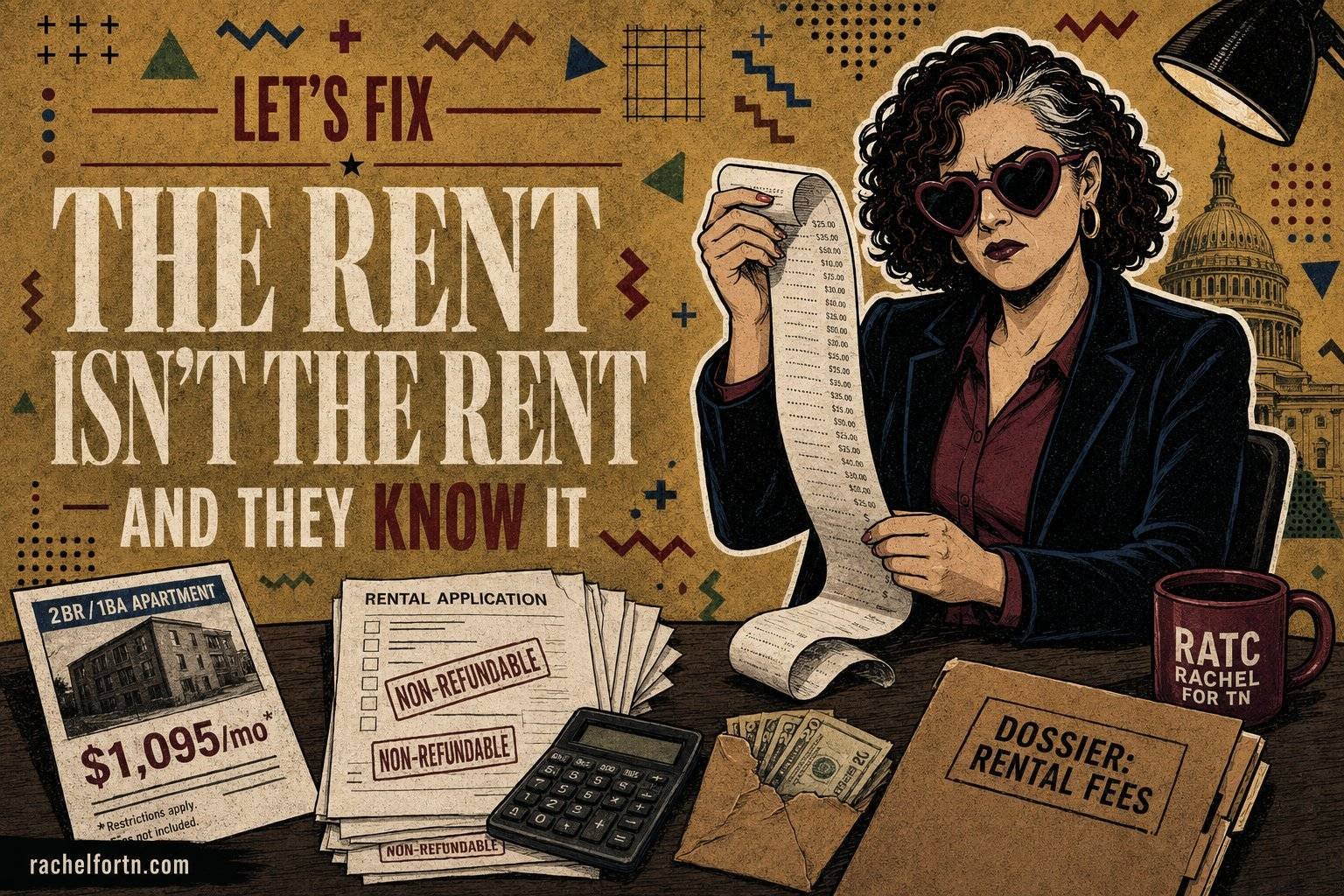
Let’s talk about rental fees.
Here’s a scenario most of us have been through. You go online to look for an apartment and find one you like. The price says $1,095 per month. That’s the number that’s in your budget.
But – as it turns out – it’s not the real cost.
By the time you actually sign, there’s a technology fee. A valet trash fee. A package concierge fee. A utility administration fee. None of those were on the listing. Add them up and your $1,095 apartment is really $1,250 or more.
And to even get to that point, you have to pay to apply for the apartment.
A lot of places charge a nonrefundable application fee – call it $50 or $60. Tennessee puts no cap on it, so landlords can charge what they want. A few years ago, I checked into a rental, and the application fee was $250. But let’s assume the average is $50.
The fee is supposed to cover a background and credit check. Those cost the landlord around $15 or $20. So when forty people apply for one unit, the landlord collects $50 forty times – $2,000 – on a unit they’re renting once. Thirty-nine of those people get nothing. Not the apartment, not the money back. They paid for the privilege of being told no.
If you’re applying to four or five places at once, because that’s what you have to do in a tight market, you can be out $300 before a single person says yes. That’s a light bill. That’s a week of groceries. Gone, with nothing to show for it.
The advertised rent isn’t the rent. The application isn’t free. And you can’t shop around on price, because the real price is hidden until after you’ve already paid to find it out.
So, how did we get here?
An application fee started out as a real thing. Running a credit check and a background check costs a little money, and a landlord passing along that small cost isn’t a scam. Neither is charging for an actual service somebody wants. That’s all fine. The problem is what it turned into – a fee charged forty times for a cost paid once, plus a stack of “mandatory” monthly fees with official-sounding names, buried until you’re too far in to walk away.
Last December, the FTC and the state of Colorado settled with Greystar – the biggest apartment manager in the country – for $24 million. The complaint said Greystar advertised low rents and then tacked on mandatory monthly fees for pest control, valet trash, package concierge, and utility administration that weren’t in the advertised price. A lot of renters didn’t find out about those fees until they’d already started the application or signed the lease – too far in to back out without losing what they’d already paid.
So why is this still legal everywhere else? Because renters don’t have a lobby and the apartment industry does. There’s no organized group in Washington fighting for the person filling out their fifth application this month. There’s a very well-funded one fighting for the people collecting the fees.
There’s a bill that would fix a lot of it. The End Junk Fees for Renters Act, H.R. 4100, was introduced last year by Maxwell Frost of Florida. It bans application fees. It bans charging you for your own background check. It caps late fees under three percent of your rent and says they can’t hit until the rent’s been late more than fifteen days. There’s a Senate version too.
I’ll be straight with you about what one House member can do, because that’s the whole point of how I want to run. One member can’t pass that bill alone. It takes the House, sixty votes in the Senate, and a signature. What a member can do is co-sponsor it, vote for it, and keep the heat on the FTC to finish a rule covering rental housing – the agency went after Greystar, but there’s still no across-the-board rule, and there should be.
Memphis is a renter’s city. Downtown, Midtown, South Memphis – a huge share of us rent, and a lot of us are one move away from running this exact gauntlet again. The rent on the sign should be the rent you pay. The application should be free, or close to it. You shouldn’t have to spend $300 just to find out the real price of a place you might not even get.
That’s a small fix. It’s also the kind of thing nobody in Washington bothers with, because the people it would help aren’t the people writing the checks. I think that’s wrong – and I will fight to fix it.