
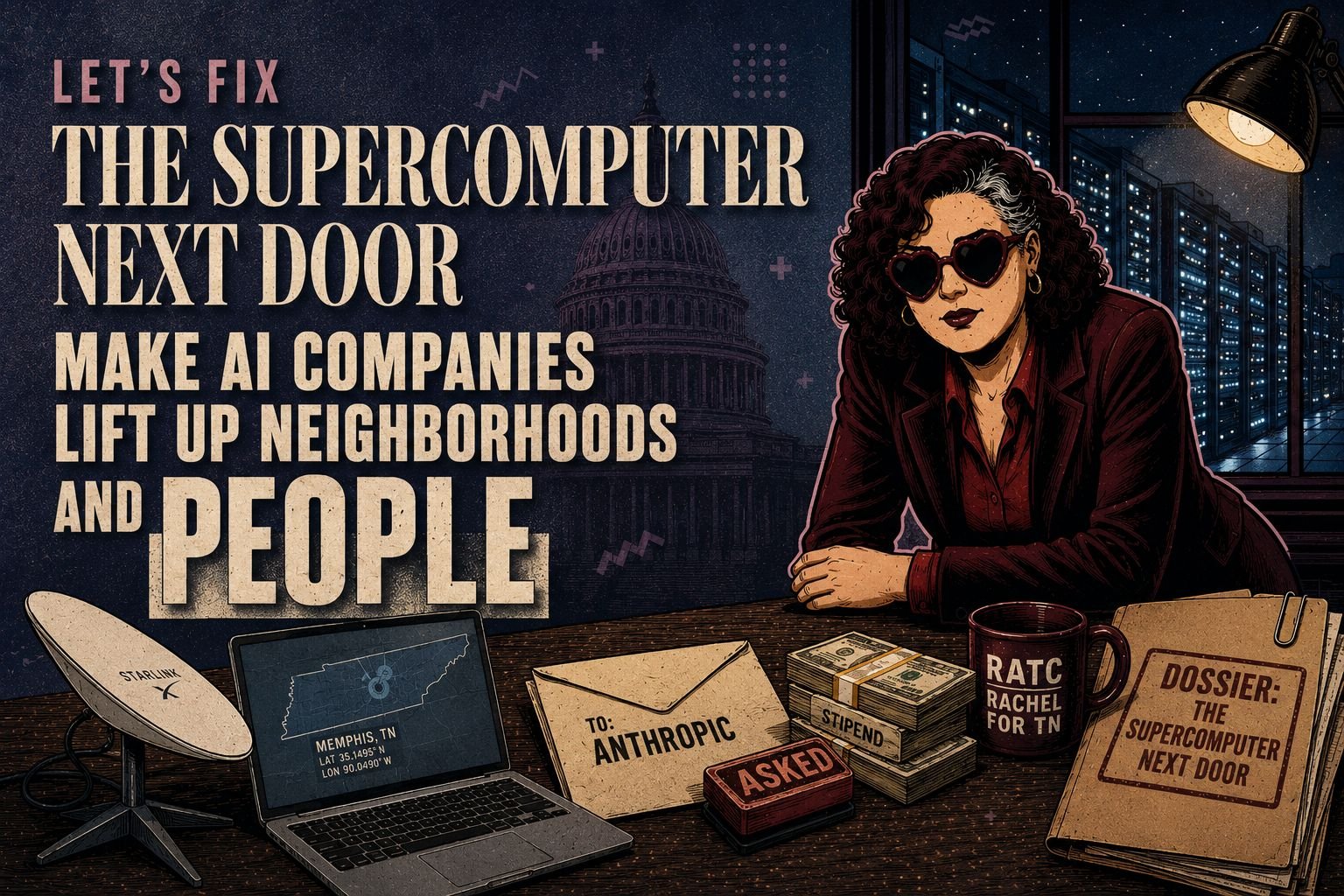
The world’s largest supercomputer sits in Memphis’ backyard. While 30,000 Memphians still don’t have internet access.
I’ve written plenty about the baggage of the xAI data centers, and I’m not taking any of it back. The gas turbines went in without permits. The air got worse. The water and the power grid are carrying the load. And I’ve been digging into the megapack battery situation to see what the fallout for that could be…
But I also want to talk about the other half – why having xAI in Memphis could be beneficial.
::ducks::
Just hear me out…
The money running through Colossus I is hard to imagine. Anthropic, the company behind Claude AI, pays $1.25 billion a month to run its models there. That number comes straight from the paperwork SpaceX filed with the government when it moved to sell stock. And it’s not just Memphis. Google runs a data center in Clarksville, at the other end of this district. District 5 hosts the AI industry at both ends of the map.
Every one of these companies says the same thing: AI is going to make life better for everyone. Fine – then prove it where you compute. There’s no better way to show that AI is a good thing than to shrink poverty in the neighborhoods that power it.
Now, some of this has already started. Memphis passed a city law sending 25% of xAI’s property taxes – up to $100 million – back into the area around the sites. xAI has also invested in Southwest Memphis schools. Google funds community grants in Clarksville. And last week, SpaceX – which owns both xAI and Starlink – gave the whole Memphis area 50% off Starlink internet with no hardware cost. Credit where it’s earned.
Now let’s finish that last thought, because it’s so close to being something real.
Around 30,000 Memphis homes still have no internet at all. In the hardest-hit neighborhoods, before the pandemic, up to 87% of people didn’t even have a computer at home. Those neighborhoods are the same ones living next to Colossus.
So here’s the ask. Don’t stop at half off. Make Starlink free, or close to it, for the neighborhoods around the data centers. And I think xAI should donate internet service to churches, schools, and community centers in South Memphis. And send computers with it, because a connection means nothing without a machine to use it.
And this is a much bigger opportunity than just a nice gesture.
It’s an education plan and a crime plan in one.
Kids can’t do homework without internet. Adults can’t apply for jobs without it. And researchers have found that when broadband reaches more homes, property crime drops – people spend more of their time connected at home. Getting a neighborhood online is one of the cheapest anti-crime investments there is.
Google already runs community investment programs – just somewhere else. Google put $50 million into training 300,000 skilled trades workers, and built a $20 million fund in Missouri to lower families’ power bills near its data center. None of that required a law. Somebody asked, and the company said yes.
And the federal government just built the other half of the equation to lift these neighborhoods out of poverty. On July 1, Workforce Pell went live – for the first time, Pell Grants cover short job-training programs, 8 to 15 weeks, in the fields these facilities hire. The TCATs and Southwest here already teach that training. The district has TCAT campuses in Newbern (Dyer County), Ripley (Lauderdale County), Paris (Henry County), and Memphis. They’re exactly the schools that Workforce Pell and the company-funded training academies would run through.
The AI build-out has made electricians, HVAC techs, and fiber workers some of the most in-demand jobs in America – hundreds of thousands of those jobs are open right now, and they pay well everywhere. Train somebody in Boxtown and they carry that skill for life, whether xAI ever hires them or not.
But here’s the truth about training that nobody in a suit ever says out loud. For most people in these neighborhoods, tuition was never the barrier. Between Tennessee Promise, Reconnect, and now Pell, the classes are mostly free already. The barrier is that you can’t quit your job for 12 weeks to sit in one. Rent doesn’t pause while you train. Neither does childcare, or the gas to get there. That’s why free programs still don’t reach the people who need them most.
The companies can fix that part, and it’s cheap for them. Pay people to train – a living stipend for 12 weeks costs about $7,000 a person, which is what Anthropic spends on compute every 15 seconds. Cover childcare and a bus pass. Fund more seats and instructors at the TCATs, because these schools run waitlists. And commit to interviewing graduates from the surrounding zip codes, because training without hiring is just a certificate on a wall.
If the AI companies pay people to train and hire them when they finish, and Pell carries the tuition, people in Boxtown stop living next to the AI economy and start getting paid by it.
I’ve already started asking these AI companies to help. Last week, I wrote to Anthropic’s leadership and asked for Memphis to be part of their community investment programs – like workforce training, an AI-skills pipeline, local hiring, and protections for the MLGW customers carrying the load. I’m waiting to hear back. I plan to ask xAI and Google to invest also.
A House member can’t order a company to invest in South Memphis, and I won’t pretend otherwise. But a House member can make the ask loud, specific, and expensive to ignore. The companies keep telling us AI will lift everybody up. The people of Boxtown are right here. Lifting starts next door.
Sources
- TechCrunch, Anthropic will pay xAI $1.25B per month for compute (SpaceX S-1)
- ABC24 Memphis, City Council passes xAI property tax ordinance (25%, up to $100M)
- Tom’s Hardware, Starlink offers 50% discount and free hardware rental in Memphis area
- Community Networks, Memphis fiber plan (32,000 households without internet)
- Here Memphis, digital divide (up to 87% without in-home computers in hardest-hit areas)
- Review of Law & Economics, Broadband Internet and Crime
- Google, $50M skilled trades training for 300,000 workers
- Labor Tribune, Google’s $20M Energy Impact Fund in Missouri
- TDLWD, Tennessee launches Workforce Pell (July 1, 2026)
- Congressional Research Service, Workforce Pell Grants