
Imagine being a slave – and not being told you were free until two years after the fact.
That’s Juneteenth.
Lincoln signed the Emancipation Proclamation on January 1, 1863 – declaring the enslaved people in the rebel states free. But paper doesn’t free anybody on its own.
It took Union soldiers showing up – and Texas was the last place they reached. So on June 19, 1865, Union General Gordon Granger arrived in Galveston and read out the order. For many of the roughly 250,000 enslaved people in Texas, that was the first official word – and the first real enforcement – of a freedom Lincoln had proclaimed two and a half years earlier.
The legal promise was made in 1863. The enforcement came later – when somebody with the power to enforce it bothered to show up.
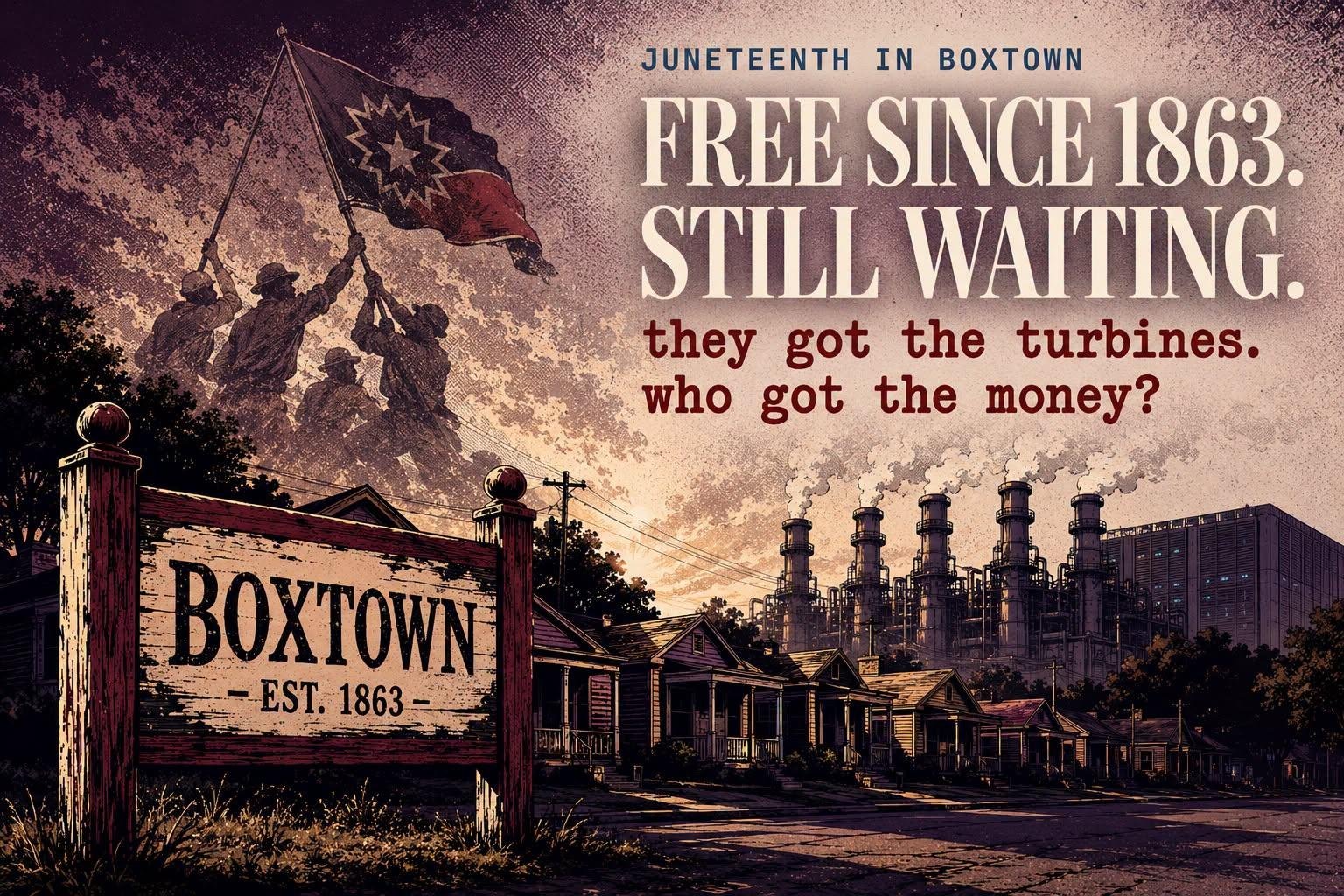
That same year – freed people started a community on the southwest edge of Memphis. They built houses out of old railroad boxcars – which is how it got the name Boxtown. The sign there still says 1863.
You might have heard of Boxtown because of the xAI data center in South Memphis. I’ll admit – I didn’t know it was called Boxtown until this issue came up a few years ago. I just thought it was South Memphis.
But I’ve driven through this neighborhood hundreds of times over the years. The main road through it is Third Street – a direct route from downtown Memphis to Mississippi. If you’ve ever gone down to the casinos in Tunica – you’ve driven through Boxtown.
There used to be an iconic skating rink there – and a drive-in movie theater. It has the Starlight – which gets named in a Lucero song. And it has an RV shop I’ve been to a bunch of times.
I’ve also got a different relationship to it than most people – because I’ve been living in a travel trailer since 2021, and I’ve stayed at T.O. Fuller State Park at least half a dozen times, for weeks at a stretch. The park sits right between xAI and the Boxtown neighborhood. I’ve hiked all over it. I even got snowed in there once during an ice storm.
Memphis annexed Boxtown in 1971 – after a failed try in 1968 – and promised sewer lines, streetlights, basic services, and residents were still fighting in court for those services into the 1980s.
Keep that in your head – because of what’s been built around there now.
xAI’s Colossus data center runs on methane-powered turbines, which emit nitrogen oxides and formaldehyde, a carcinogen. The neighborhood they sit next to already carries a cancer risk environmental groups put at four times the national average – and Shelby County gets an F for ozone from the American Lung Association.
After the NAACP threatened to sue, xAI pulled most of them and got a permit for the rest. Then it built a second data center and did the same thing again – this time running the turbines just across the state line in Southaven, Mississippi.
The Clean Air Act says you can’t run a major source of pollution like that without a permit. That’s the law – and it’s as real as the Proclamation was. The only question that ever matters is who shows up to enforce it.
When the federal government wouldn’t – the NAACP did it themselves. The law lets ordinary citizens sue polluters directly when the government won’t. It’s called a citizen suit – it’s been a tool for fifty years – and the NAACP filed one this spring over the Southaven turbines powering that second Memphis data center.
This week, the Trump administration stepped in.
Not to enforce the law – to kill the lawsuit.
The Justice Department asked the court to throw the case out – arguing that it’s up to the executive branch alone to decide when the Clean Air Act gets enforced, and that the AI the turbines power is a matter of national security.
So the federal government walked into court on the side of the polluter – to take away the one tool the neighbors had left. The administration didn’t fail to show up the way the Union took two and a half years to reach Galveston. It showed up to give citizens the middle finger.
Now. Let’s look at what Memphis got for hosting all this.
xAI is reported to be on the hook for more than 30 million dollars a year in combined city and county property taxes. The city carved out 25 percent of its share of the first site for the surrounding neighborhoods – about 3 million, spread across a five-mile radius that covers 78 square miles, not just Boxtown.
Three million over an area that size is about the scale of one small project. Most cities hosting one of these got nothing carved out at all – so credit for doing more than nothing. But nobody in charge wants to answer for the other twenty-seven million. It drops into the general fund and gets spread across a city that has spent a hundred and sixty years spreading its attention everywhere except here.
Boxtown is the neighborhood closest to the Memphis site – the one being asked to live with the turbines – the way it’s been asked to live next to every refinery and dump for a century. So, I think Boxtown should get all of the money. Not a slice of one site’s city taxes – the whole xAI haul – and the city should spend it nowhere else until that neighborhood has seen a real turnaround.
The city already knows what could help that neighborhood – because residents told them in the city’s own survey.
Fix the homes – roofs, HVAC, lead and contaminant removal in houses that have sat in industrial air for decades. Build the sidewalks the neighborhood never got. Put a real health clinic in a ZIP code carrying that kind of cancer risk. Stand up independent air monitoring – so nobody has to take the polluter’s word for what they’re breathing. And give residents direct say over the spending – instead of deciding it for them.
Now the honest part – how Memphis spends that tax money is the city and county’s call. The Memphis air permit is Shelby County’s fight – the Southaven one is Mississippi’s. A member of Congress doesn’t get a vote on any of it. I could be as loud as hell about all of it – in Nashville and at City Hall – and still be standing outside the room.
The federal end is a different story – and it’s exactly what the administration is going after.
Congress wrote the citizen-suit right into the Clean Air Act – and Congress can defend it. A House member can co-sponsor Steve Cohen’s Clean Cloud Act – which would make big data centers report publicly what they burn and what they emit – instead of leaving neighbors to fly drones over the turbines to find out.
A member can haul this into a hearing and make the people signing off on these turbines answer in public. And a member can refuse to let the executive branch quietly turn “we’ll enforce the law when we feel like it” into the law itself.
Juneteenth isn’t really a story about freedom arriving. It’s about freedom arriving late – on purpose – to the people furthest from anyone who’d enforce it. Boxtown has been living the slow version of that since the year it was founded. The least we owe them now is to not let the government finish the job.
Send me to Congress, and I’ll fight for what’s right.
Sources
- National Archives – General Order No. 3 and Juneteenth
- Boxtown, Memphis – founding (1863), boxcar homes, 1968/1971 annexation
- StoryBoard Memphis – Boxtown’s fight for city services after annexation
- Climate & Capital Media – xAI Colossus turbines, NOx and formaldehyde, Colossus 2 in Southaven
- Southern Environmental Law Center – Clean Air Act findings on xAI turbine emissions
- The Hill – DOJ moves to dismiss NAACP Clean Air Act suit over Southaven turbines
- Smart City Memphis (citing Daily Memphian) – xAI combined city/county taxes, 25% neighborhood set-aside within five miles
- Rep. Steve Cohen – Clean Cloud Act (H.R. 6179)