
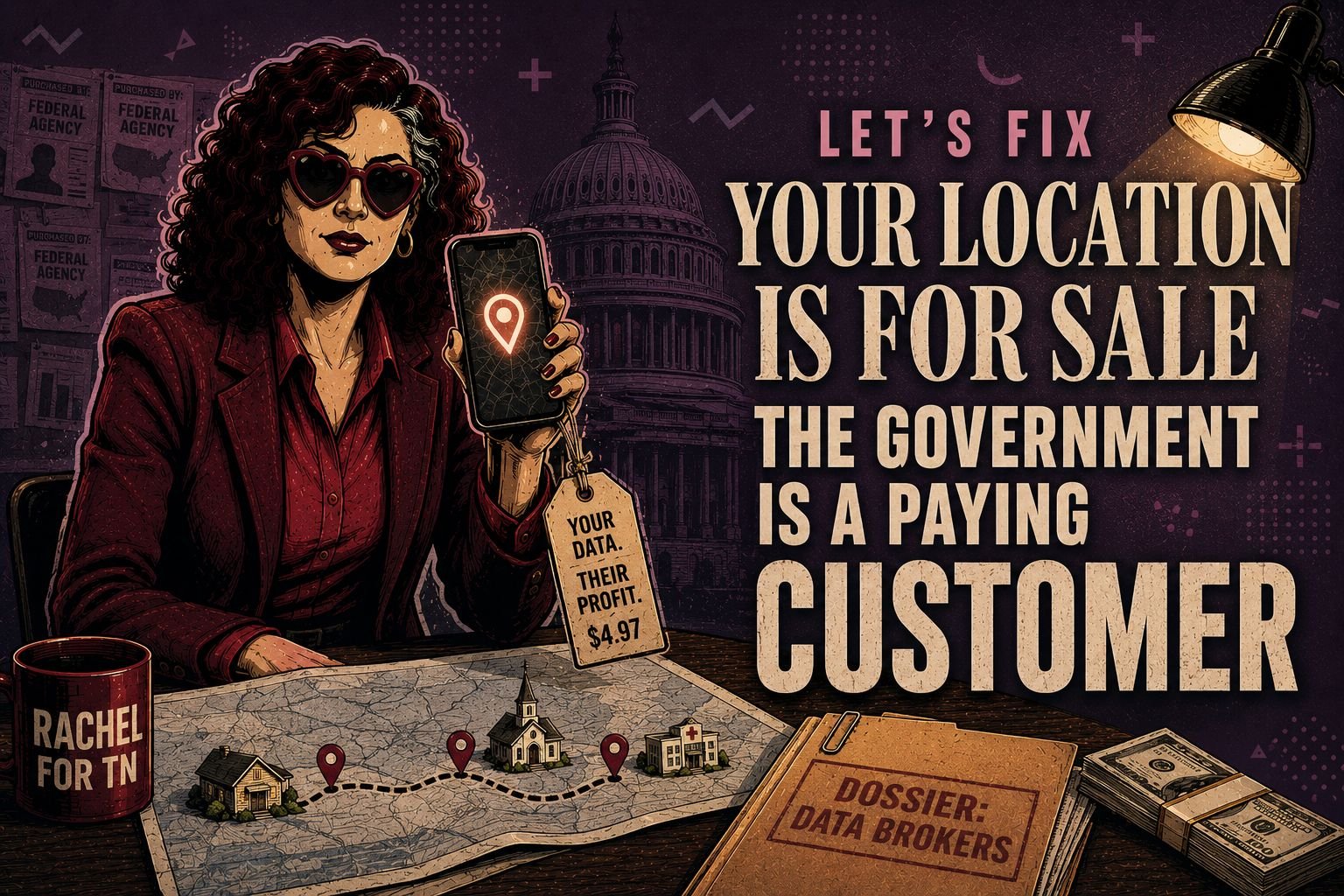
Your phone told somebody where you slept last night. Nobody hacked it. The apps on it are built to share your location, and a whole industry exists to buy it.
Here’s the pipeline. You download a free app – a weather app, a game, a prayer app, a period tracker. The app grabs your location and feeds it into the online ad system. Data brokers scoop it up from there and pour it into giant searchable databases. One broker bragged that it collects more than 15 billion location points from 250 million phones every single day. When reporters got a leaked file from another broker, the apps in it included Candy Crush, Tinder, MyFitnessPal, and pregnancy trackers. Most of the app makers said they’d never even heard of the company.
Now ask yourself a question. Almost every other rich country on earth has a national data privacy law. America doesn’t. Congress has been “working on it” for 25 years. Why can’t the most powerful legislature in the world manage to protect your data from an industry everybody hates?
Because the government is the customer.
ICE, CBP, the FBI, the Secret Service, and even the IRS have all bought location data from these brokers. In 2018, the Supreme Court ruled that if the government wants your location history from your phone company, it needs a warrant. The workaround took about five minutes to find – don’t ask the phone company, just buy the same information from a broker. There’s no warrant and no judge, just a purchase order. Regulating the data broker industry would mean shutting down the government’s own back door. So the back door stays open.
This isn’t me being paranoid. The government’s own watchdogs have said it. In 2023, the Homeland Security inspector general found that CBP, ICE, and the Secret Service broke federal privacy law with these purchases. In 2025, the FTC ordered one of the brokers to stop selling location data because it was tracking people to doctors’ offices, churches, and political events – and the people being tracked never really agreed to any of it.
Watch what happens when Congress tries to close the loophole. The Fourth Amendment Is Not For Sale Act says the government can’t buy data it would need a warrant to seize. It was written by a conservative Republican, co-sponsored by progressive Democrats, and it passed the House 219 to 199 in 2024. Then it died in the Senate without a vote. The agencies doing the buying fought it the whole way. When a senator asked the FBI director this year to commit to stop buying Americans’ location data, he refused. When Congress scheduled a briefing to ask ICE about its newest location tracking contract – a no-bid deal for a tool that can watch every phone on a city block and follow them home from work – ICE canceled it the day before and never rescheduled. The referee is betting on the game. That’s why the rules never change.
And here’s why it matters in this district. These tools don’t just track suspects. A geofence search grabs every phone in an area – everyone at the church, everyone at the clinic, everyone at the protest, everyone at the county fair. The same federal machine buying this data has agents working in Memphis right now. From downtown Memphis to Williamson County, we’re all in a database we never agreed to be in.
The fix has a name and a vote count, and one House member can co-sponsor it, vote for it, and remind people it already passed once. But the honest version is this: Congress won’t shut down a surveillance tool its own government is using. The pressure has to come from outside – from voters who understand the conflict of interest and say it out loud.
While they stall, do one thing tonight – turn off your phone’s advertising ID. On an iPhone, it’s under Settings, Privacy and Security, Tracking. On Android, it’s under Settings, Privacy, Ads. It takes 30 seconds and it makes you much harder to follow.
I’ve written about the cameras reading your plates and the software scanning your face. This is the third leg of the same stool. The Constitution says the government needs a warrant to search you. A credit card shouldn’t beat the Constitution.
Sources
- New records detail DHS purchase and use of vast quantities of cell phone location data – ACLU
- Van Hollen, Wyden and over 65 Democrats call for investigation of ICE, DHS warrantless location data purchases
- The government uses targeted advertising to track your location – EFF
- House passes Fourth Amendment Is Not For Sale Act – ACLU
- H.R. 4639 – Fourth Amendment Is Not For Sale Act – Congress.gov
- How an ICE contractor tracks phones around the world – VICE
- Black Memphis residents report harassment by Trump’s police task force – ProPublica/MLK50