
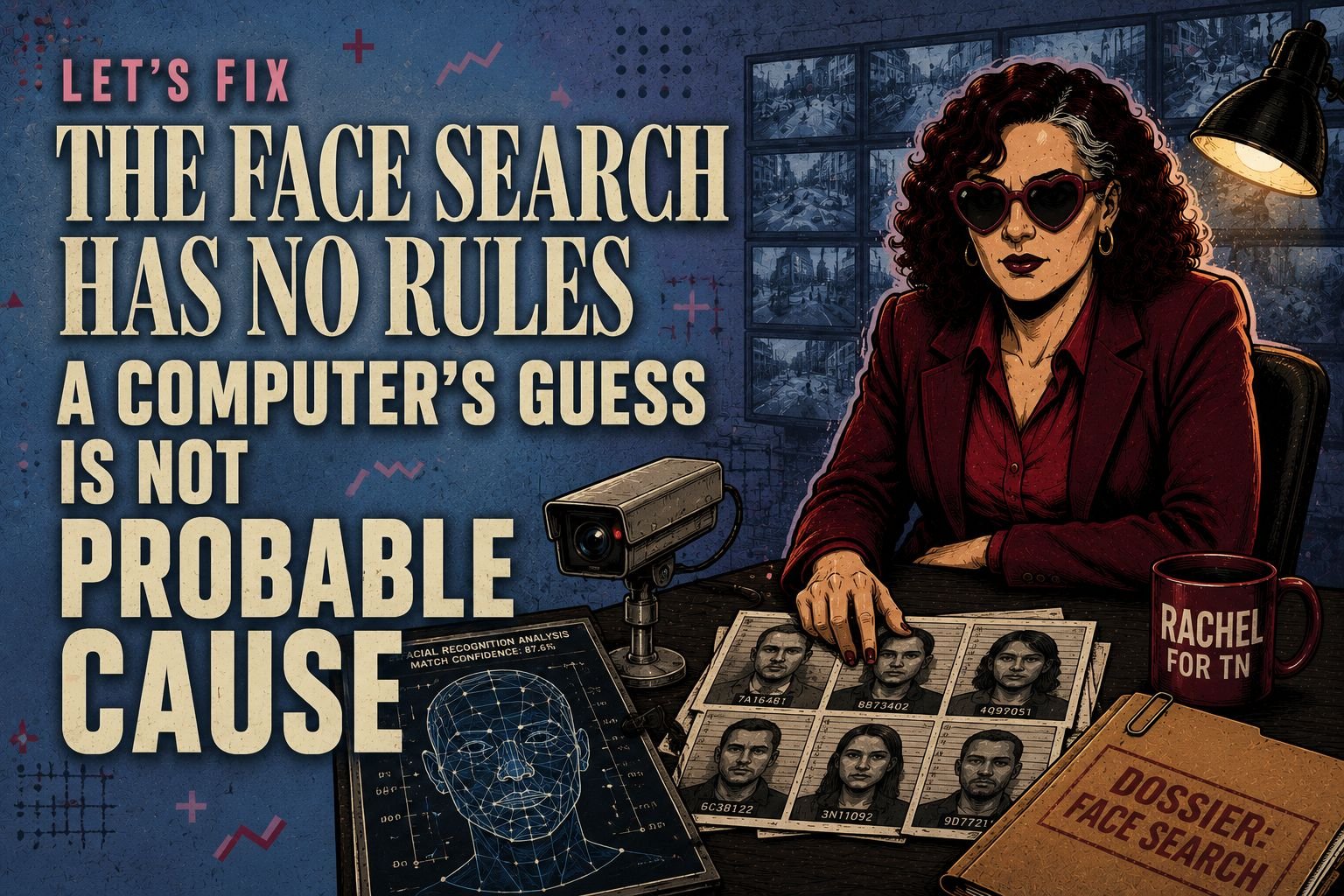
Now that I have your attention on the Flock Camera issue – I think it is worth revisiting an issue I’ve been writing about that should be just as chilling – if not more.
In January 2020, Detroit police arrested a man named Robert Williams on his front lawn, in front of his wife and his two little girls. He spent 30 hours in a dirty, crowded cell. He hadn’t done anything. A computer picked him.
A watch store had been robbed two years earlier. Police took a blurry frame from the security video and ran it through facial recognition software. The software matched it to an expired driver’s license photo of Williams.
He wasn’t even the software’s best guess – he was the ninth-best match. Nobody checked where he was that day before they arrested him.
Facial recognition is exactly what it sounds like. A computer scans a photo of a face and hunts through millions of other photos – mugshots, driver’s licenses, social media – looking for a match. About two-thirds of police agencies in this country use it in some form, according to the federal government’s own watchdog.
And there’s no federal law that says how. No accuracy standard. No warrant requirement. No rule against a match being the whole case.
The software also gets Black faces wrong more than white ones.
The government’s own testing found that error rates were highest for Black women. At least seven people in this country have been arrested for crimes they didn’t commit because of a bad match. One was a Detroit woman who was eight months pregnant. Police held her for 11 hours on a carjacking charge. The carjacker was not pregnant.
Williams sued. In 2024, Detroit paid him $300,000 and agreed to the strictest facial recognition rules of any police department in the country. Police there can’t arrest anyone on a software match alone anymore. That fix didn’t come from Congress. One man fought one city and won.
So where’s Memphis in all this?
MPD already runs an AI-powered command center downtown, with dozens of cameras and drones feeding it. When the police chief was asked about facial recognition, she said the cameras are used “only for objects” and that “we are not using our technology at this time for that.”
At this time.
Memphis has no ordinance on police facial recognition – not a ban, not a rule, not even a reporting requirement. At least 16 American cities have one.
Meanwhile, reporters just uncovered a Homeland Security plan to hand facial recognition apps to local police who work with ICE – the same app federal agents already carry, which stores every scanned face for 15 years. And Memphis police are working alongside 31 federal and state agencies in the Memphis Safe Task Force right now. The only thing between those cameras and your face is a decision nobody has to ask your permission for.
I’ve been writing about this the whole campaign – the license plate cameras logging every car in Shelby County, the world’s largest supercomputer going up in our backyard, the AI report Congress ordered and then ignored, and a whole page of receipts on what’s true and false about data centers.
It’s all one story. The machines are being pointed at regular people, and nobody with power is writing the rules.
Here’s where you come in.
All over this district, people are already showing up to county commissions to fight data centers – over water, over power bills, over the turbine exhaust Boxtown has been breathing. Keep fighting those fights.
But we need to add this to the list, because what runs inside those buildings is the software that scans your face, reads your plate, and grades your life. When you petition your local government about a data center, petition them about data privacy in the same breath.
And be clear-eyed about where the fix comes first.
Congress should set a floor – a warrant and accuracy standards before police run a face search, and no arrest on a match alone. That’s the Detroit rules made national, and a House member can push for it.
But I won’t pretend a federal law is coming fast.
Congress’s own AI task force wrote a 250-page report and went home. The faster fix is local.
In Oakland and San Francisco, police have to bring surveillance tech purchases to elected officials in public before buying – a written use policy and annual reporting. Memphis could pass that with a single council vote. Yes, the state legislature has overridden Memphis before. Fight anyway. Make them do it in public, on the record, in an election year.
Robert Williams was arrested in front of his daughters because no one checked the computer’s work. The rule we need is one sentence long: a computer’s guess is not probable cause.
Sources
- Williams v. City of Detroit – ACLU
- Facial recognition in policing is getting state-by-state guardrails – Stateline
- Detroit takes important step in curbing the harms of face recognition technology – EFF
- Facial Recognition Technology: Federal Law Enforcement Agency Efforts – U.S. GAO
- Mayor Young unveils AI tools and strategies for downtown and beyond – Tri-State Defender
- The movement to ban government use of face recognition – EFF
- DHS plan to give local police facial recognition tech – NPR
- Black Memphis residents report harassment by Trump’s police task force – ProPublica/MLK50