If you're actually interested in the air quality issues in South Memphis - buckle up.
The big question I keep getting is: okay, what's your solution?
That's fair. And before I answer it, I want to make clear that I don't doubt for one second that people are suffering. What I can't tell you - what nobody can tell you right now - is whether that suffering is caused by xAI, by the refinery, by the steel mill, by the coal ash, or by the ozone this whole region has failed on for years.
Here's a hard truth about how people work: when you learn that machinery moved in next door, every cough starts to feel like evidence. That's not a character flaw. That's normal. It's also exactly why we measure things instead of guessing.
South Memphis has earned every ounce of its distrust the hard way - a pipeline company once called this community the path of least resistance, the old Defense Depot leaked poison for decades, and promises made to these neighborhoods have been broken for longer than I've been alive.
So people deserve better than my comfort or my assumptions. They deserve the truth about what's actually in their air and where it's coming from, because that's the only version of caring that leads anywhere. If it's xAI, we need to be able to prove it.
This community's been fed bad info by companies, by agencies, and by politicians for fifty years. The most respectful thing I can do is not add to the pile. So I spent this week inside the documents, and I want to show you what I found.
It started with a comment. Somebody told me the EPA had tested the air here and found clear pollution problems. That surprised me, because I'd been following this fight for a while and I'd never seen an EPA test. So I went looking for it.
I found no public record of one.
As far as the public record shows, the EPA has never done air testing around the xAI site. What I found instead were the four things people keep mistaking for it.
There's the EPA's emissions inventory - a database where factories report their own pollution numbers. An analysis of the 2017 version found Southwest Memphis facilities accounted for 94% of the county's reported factory emissions of the six main tracked pollutants [1]. That's a factory-reporting database, not air testing, and it's from 2017 - seven years before xAI existed.
There's an EPA rule from Jan 2026 about gas turbines - the machines that power the place, basically jet engines that burn natural gas to make electricity. The rule clarified that turbines mounted on trailers can still count as regular pollution sources that federal standards apply to. It was a rule change, not a test, and the EPA said it doesn't apply backward in time [2].
There's the American Lung Association giving Shelby County an F for ozone - the main ingredient in smog - and calling it the worst county in TN for it. But that grade's built from existing monitor data, not new testing [3].
And there's a community sensor project that gets called "the EPA study" online, except it was run by MCAP and a research group called CEEJH, not the EPA [4].
So I decided to read every air study that actually exists for this neighborhood. There are four. It didn't take long, because that's how thin the record is for the loudest environmental fight in Tennessee.
The city's test came first, in June 2025. Memphis hired an outside lab called EnSafe to sample the air at three spots, including Boxtown, for about 12 hours on each of two days. They checked ten pollutants and reported nothing above the safety levels they compared against [5].
Then I read the criticism, and most of it holds up. Two days is a snapshot, not a picture of what people breathe year round. The test skipped ozone completely. The wind wasn't blowing from xAI toward the Boxtown sampler on either day, and that sampler sat tucked near a building in a way that may not have followed the EPA's placement guidance [6][7].
There's one more problem that got less attention - some of the comparison levels the city used were workplace safety limits, the kind written for healthy adults on a shift, not for babies and grandparents breathing the air around the clock. The Southern Environmental Law Center put out a statement calling the results irresponsible [8]. On the setup, they had a point. If that test was meant to reassure people, I understand why it did the opposite.
Then I read the U of M analysis, and this is the one that deserves more attention than it gets.
Professor Chunrong Jia's team built a computer model of the turbines' pollution, then checked it against satellite readings of fine particle pollution - specks so tiny they slip past your nose and throat and lodge deep in your lungs. They compared readings from before and after the data center opened. Their finding, published in The Conversation: the turbines "had not measurably degraded air quality in the surrounding neighborhoods," with the model estimating xAI's normal operations add about 1% to the particle level [9].
Two honest caveats, both flagged by the researchers themselves. The model ran on pollution numbers xAI reported about itself, which Jia admitted carry huge uncertainty. And it assumed the turbines ran normally the whole time, with no breakdowns.
Jia was also blunt about the part that should reframe this whole fight - particle pollution in that area was already elevated before xAI showed up. It still is. The people there weren't breathing clean air that a data center ruined. They were breathing dirty air that nobody in power treated as an emergency until Elon Musk came to town.
The TIME analysis came next, and it took me a minute to understand why both sides quote it. TIME paid University of Tennessee researchers to measure a gas called nitrogen dioxide using satellite data. Nitrogen dioxide comes off anything that burns fuel - car engines, power plants, these turbines - and it's one of the main ingredients that cooks into smog.
The researchers measured two different things, and this is the part that matters. First, the average - the normal level of the gas over time. Second, the peaks - the worst moments.
The average barely moved after the turbines started, up about 3% once they adjusted for weather. The peaks told a different story. Inside Boxtown, the worst spikes ran 9% higher. In the satellite grid squares right around the data center, the worst spikes ran 79% higher [10].
Put those numbers side by side and they make physical sense - pollution's strongest near the machines making it and thins out as it drifts. But here's the limit the researchers flagged themselves: a satellite can see that the gas went up, it can't tell you whose smokestack it came from. TVA's Allen power plant sits right next to xAI - I've driven over there and seen how close they are. It ramped up its own generation in the same window, and the road between xAI and TVA is full of 18 wheelers that never stop.
So all the numbers are real, they all sit in the same analysis, and none of them can be pinned on one thing.
The last one was the community project, and it held the biggest surprise for me. MCAP and CEEJH ran low-cost air sensors around South Memphis for four winter months. Their headline finding: particle readings frequently above 9 micrograms per cubic meter, the level the federal yearly standard is set at.
How often depended on where you stood - about 44% of hours at their Boxtown sensor, 75% at Westwood/Whitehaven, 33% at their Southaven site, and 62% across the network as a whole [4].
One technical honesty note, because it matters: the federal particle standard's a yearly average, so you can't call any single bad hour a legal violation. What those readings show is a neighborhood breathing elevated particle levels a lot of the time, which is reason enough to demand real monitoring.
And buried in their own report was a detail almost nobody covered. Their winter ozone readings - the exact pollutant everybody hammered the city for skipping - came in generally lower, with periodic spikes, and the researchers said summer data's needed before anyone can draw conclusions [4][11].
Their critics have fair points too. The sensors aren't the kind the gov't accepts for official readings, and the health dept says that type can read high in cold damp weather - the researchers say they corrected for it. But four months of data in a neighborhood with a refinery, a steel mill, and a gas plant can't tell you which smokestack the particles came from [11]. That last part matters more than people realize. If the particles are coming from the refinery, shutting down xAI wouldn't help the family breathing them one bit.
I also went looking for the health numbers, because surely somebody's tracked whether people actually got sicker after the turbines came on. I found no public study of it - no before-and-after look at ER visits, hospital stays, or school absences.
The frightening cancer figure everybody quotes traces back to a 2013 U of M study that measured toxic chemicals in Southwest Memphis air and calculated that a lifetime of breathing them would carry a cancer risk about 4 times the national average [12]. That's a risk estimate computed from measured toxins - not a count of actual cancer cases - and the air samples behind it were collected around 2008 to 2010, long before Elon Musk ever heard of Boxtown.
And when I read the study itself, I found the detail that nobody on any side of this fight ever mentions. The researchers traced where that risk actually came from, and it was mobile sources - the trucks, trains, barges, and planes moving through that corridor - that drove 57% of it. Industrial sources drove 14% [12].
The most famous statistic in this whole fight, the one everybody points at the factories, was mostly traffic by its own authors' math.
That doesn't excuse the factories. One of the study's top three risk chemicals, formaldehyde, is exactly what the turbines emit today - which is a reason to measure it, not a reason to relax. But it should stop everybody cold for a second. The number this community's been organizing around describes a different villain than almost anyone assumed. That doesn't make any of it less urgent. It makes it more urgent, because it means the problem's bigger than the villain everybody's pointing at.
So - four studies. Two lean one way, two lean the other, and here's the honest summary of all of them together. No study's been able to isolate what xAI specifically added to this neighborhood's air, because that would take regulatory-grade monitors sitting near the site, and those don't exist.
The satellite work did find nitrogen dioxide rising after the turbines started - but it can't separate xAI's share from the power plant next door. The particle work found no significant change - but it leaned on xAI's own numbers. And nothing, anywhere, establishes that the air is safe. Every path through the evidence dead-ends at the same missing thing.
Now here's something that should actually piss people off.
Effective Aug 1, 2024, the EPA awarded the Shelby County Health Dept $411,000 to build a real-time air monitoring station in South Memphis [13]. The concrete pad got poured Aug 14, 2025 - more than a year later. In March 2026, the health dept was running the legally required public comment process just to add the site to its official monitoring plan, aiming for May or June [14].
And here's the detail that deflated me when I read the plan: the station's designed to measure carbon monoxide and ozone. Not fine particles. The pollutant at the center of the community's strongest data isn't in the plan [14].
One more thing I learned from the county's own records - ozone monitoring here is seasonal. The county plan runs it March through October, so even the pollutant the new station will track goes dark from November through February [14]. And it's still not functional.
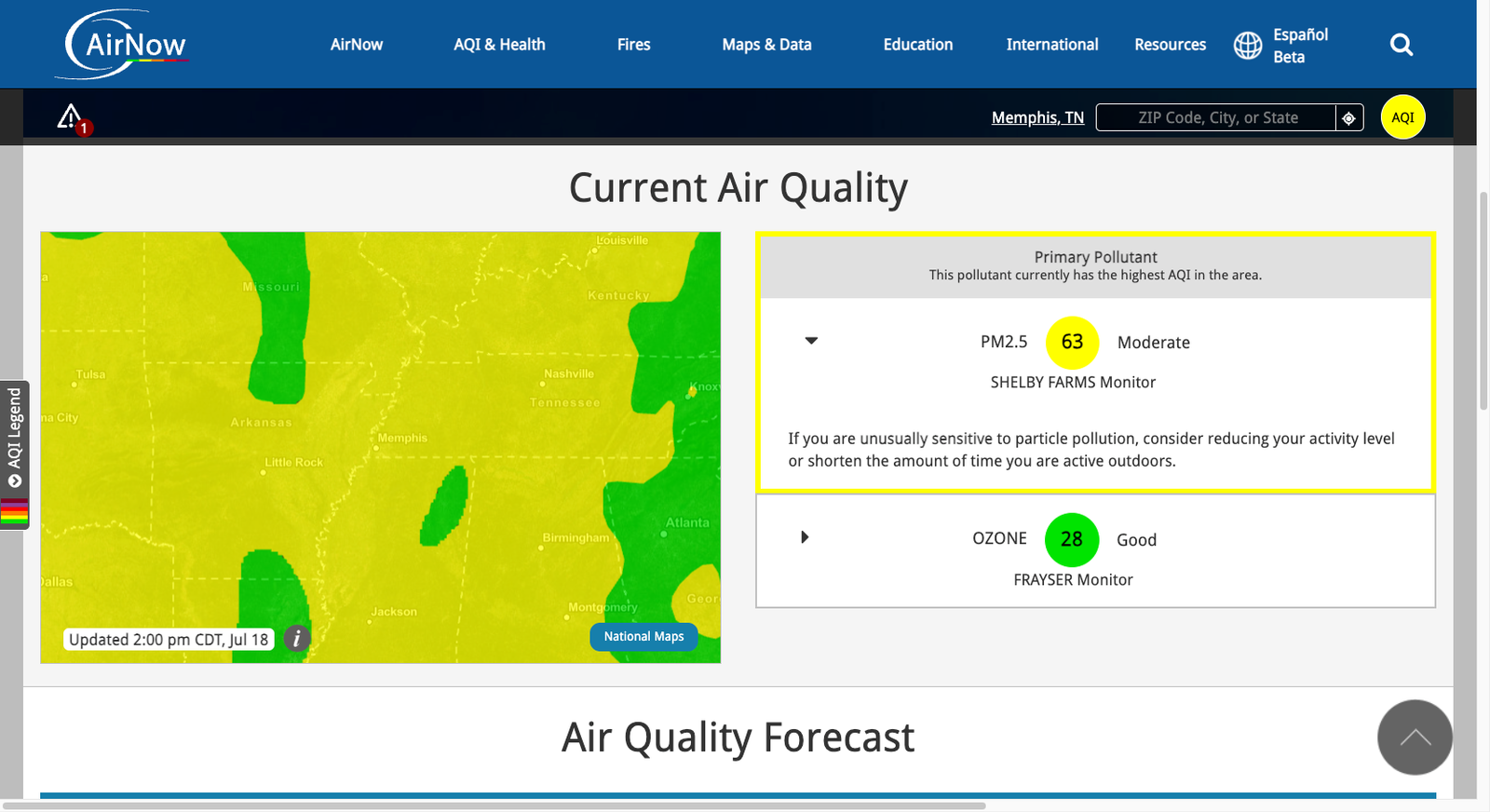
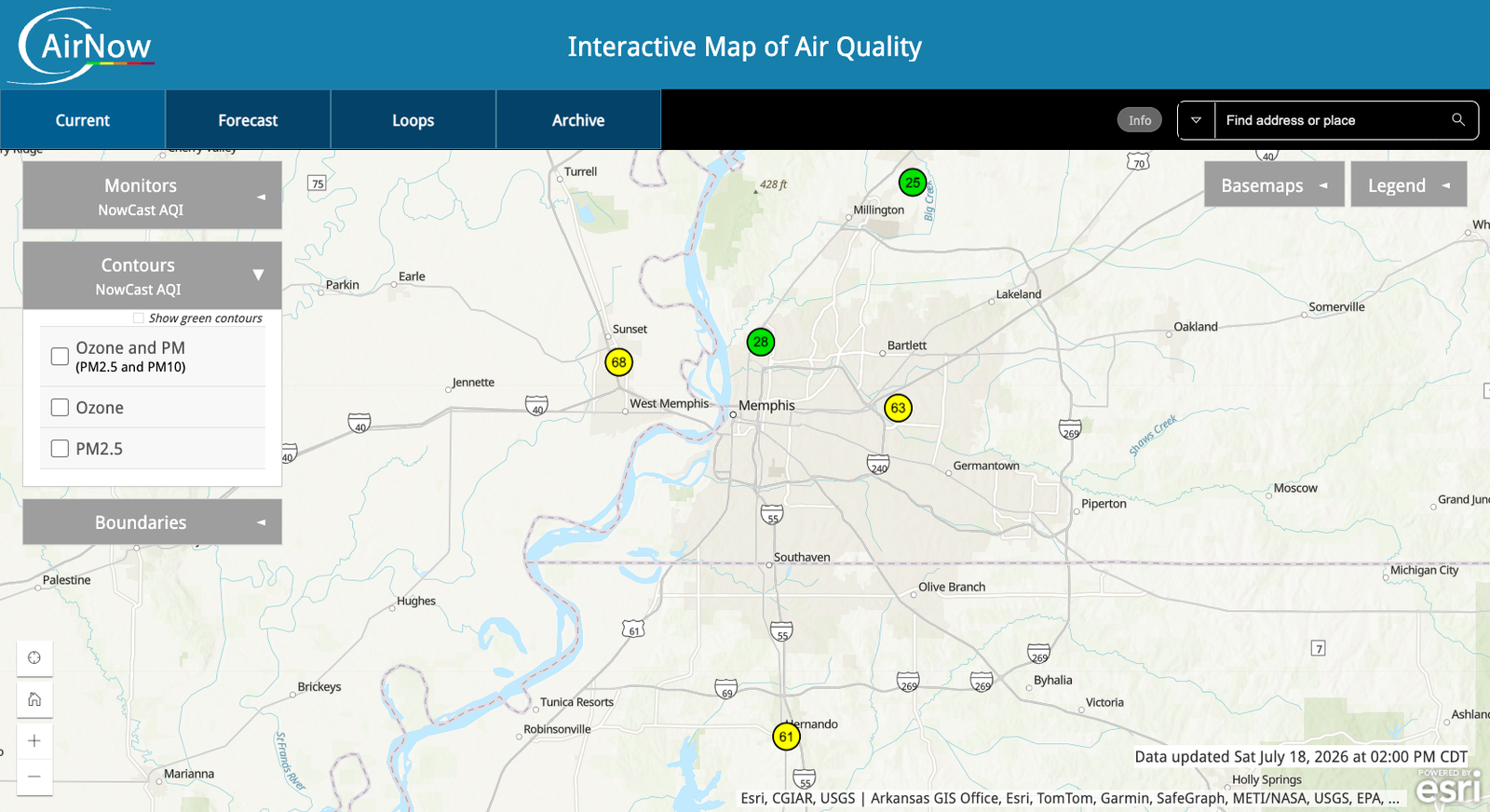
So this morning I did the simplest thing I could think of. I pulled up AirNow, the gov't's own air quality website, and looked at where Memphis's official numbers were coming from. The fine-particle reading displayed for the Memphis area came from a monitor in Marion, Arkansas. The ozone number came from Frayser, about 15 miles from Boxtown [15].
For more than ten years, there's been no official air monitor anywhere in South Memphis, and I found no public confirmation that the new station is reporting data yet.
That's why every study's weak. That's why both sides can wave data at each other forever. You can't settle an argument about air nobody's measuring, and the people caught in the middle of that argument are the ones breathing it.
One thing I should untangle before I get to the plan, because two different stories keep getting merged into one.
Colossus 1 sits in southwest Memphis near Boxtown. Its permit, issued July 2, 2025, covers 15 turbines with pollution controls [16]. It says those turbines "can only run 110 hours a year." But the 110-hour limit only counts startup and shutdown time - the dirtiest minutes, when the permit's own emission limits don't apply.
The permit contains no cap at all on total running hours. What limits them instead is a yearly ceiling on pollution emitted - no more than about 87 tons of smog-forming nitrogen oxides, for example [16].
You've probably also heard them called "backup" turbines. The permit never uses that word. Backup is how the company and the Chamber describe them, so I put in a records request to find out what they actually do.
Colossus 2 is a different animal entirely. The building sits in the Whitehaven area of Memphis, but its power comes from across the state line in Southaven, MS - and there are two separate turbine stories there that keep getting mashed together.
There are 60 portable turbines there, per the inventory xAI's consultant filed with Mississippi regulators in June [24]. None of them holds a federal clean air permit, and xAI and Mississippi regulators dispute whether the portable units need one [17].
Separately, Mississippi issued a permit in March for 41 permanent turbines at the same site, and that plant is under construction now [18][24]. The NAACP's suing over the unpermitted ones in a Mississippi federal court, and no judge has ruled on the merits yet [17]. Tennessee can't issue or pull a Mississippi air permit, so that fight runs through Mississippi and the federal court. It's a whole other can of worms, and everything in this essay is about the Memphis side.
I've made a list of who actually holds power over any of this, because the answer isn't rally speakers, and it isn't me unless you send me to Congress.
The Shelby County Health Dept issued the Colossus 1 permit and runs the monitoring network. The local Air Pollution Control Board handles appeals and variances when somebody challenges a permit.
The Memphis City Council passed the ordinance steering 25% of xAI's city property taxes to the surrounding neighborhoods, and it could pass more [19].
The EPA enforces the Clean Air Act - the federal law that sets the limits on air pollution - and funds monitoring, usually through local health depts like ours. TDEC, the state's environment dept, takes state-level complaints. Mississippi's environment dept permits the Southaven turbines.
Federal courts are hearing the NAACP case. MLGW proposes the water and power rates, and the City Council approves them. The TVA - the gov't-owned power company that supplies this whole region, with a board nominated by the President and confirmed by the Senate - plans how much grid power gets built here. And Congress oversees the TVA and the EPA and writes the laws for the next data center.
So what would I do about all of this? Once I could see the whole board, the plan wrote itself.
I already started on the first part. This week I filed two public records requests - formal demands that force the gov't to hand over its documents. Any citizen can file one, and I'll publish whatever comes back.
One went to the health dept for records showing each turbine's actual dates and hours of operation - the permit requires xAI to keep monthly fuel and pollution records, logs of every startup, shutdown, and malfunction, and to file reports twice a year [16] - plus every air complaint filed from the 38109 zip code. That'll replace dueling stories with an operating record.
The other went to TDEC, because I've seen it reported that families near the site filed complaints with the state and got turned away. I can't verify that yet, but it's exactly what the records request is for - if families asked their gov't for help and got told no, I want the record of it, and I want to know whether the reason was money, staffing, or something worse.
The second part is already in motion, and almost nobody noticed.
The construction permit told xAI to apply for a permanent operating permit once the turbines started up, and the company did - for 12 turbines instead of 15. The county posted that request back on April 7, in the legal notices section of the paper, with a 30-day public comment window and a plain statement that the health dept "intends to issue" the permit [20]. One detail in that notice ties this whole story together: the new permit would write the EPA's Jan 2026 turbine rule directly into xAI's operating requirements.
Here's the part that should bother you. That comment window opened and closed in the spring while everyone was arguing on Facebook, and more than two months later, no decision's been publicly reported.
The quiet conversion of a temporary permit into a permanent one is the real next decision on the xAI that already exists - not any bill in Congress, and not the construction permit's Jan 2, 2027 expiration date - and it's moving through the system with almost nobody watching.
So I'm requesting the full file: the application, every comment that came in, the county's answers, and the decision when it lands. The rules allow an appeal within 30 days of a decision, and when that clock starts, I'll publish the deadline and show District 5 exactly how to be heard. If you want the permanent permit to require public disclosure of when those turbines actually run - instead of self-reporting twice a year - the appeal window's the next door in, and I'll make sure you know the moment it opens.
The third part is the boring fix that settles everything downstream - a real monitoring network.
I mean the official kind: federal reference monitors run under an EPA-approved quality plan, placed upwind and downwind of the industrial corridor, measuring the pollutants actually in dispute - fine particles, nitrogen dioxide, ozone, and formaldehyde - with the data live on the internet. The station currently planned measures carbon monoxide and ozone, which means the fine-particle question stays unanswered even after it turns on [14].
This would protect South Memphis from every polluter around it, not just the famous one, and it's the one thing every side of this fight says it wants. That makes it the easiest federal ask on the board, and I'd make the ask.
Fourth, I'd vote for the AI Data Center Site Selection Transparency Act, the bill introduced in the House this spring [21].
Here's what it actually does - no more, no less. It makes developers disclose a proposed data center's location at least 180 days before taking a definitive step toward building, disclose estimates of the power and water it'll need, provide an environmental impact analysis prepared by an independent third party the developer pays for, do real multilingual outreach in the affected community, and it limits the hush agreements between developers and gov't bodies that kept the Memphis deal secret until the machines showed up.
It gives communities notice and a voice, not a veto - I want to be honest about that. But Memphis found out about the turbines from the news, and this bill makes that impossible next time.
I've also said that if the AI Data Center Moratorium Act - the federal ban on new data center construction introduced by Rep. André Carson, with Sen. Sanders and Rep. Ocasio-Cortez behind it - came to a floor vote, I'd vote for it [22]. But I won't pretend it does something it doesn't. A ban on new data centers doesn't remove one turbine, one permit, or one gallon of anything from the data centers here that are already built and running. The transparency bill covers the future. The operating permit, the records, and the monitors deal with the present, and the present is where those families live.
And the fifth part came straight out of that timeline. I'd make the agencies show they can actually do their jobs.
Congress should ask why an EPA monitoring grant awarded in Aug 2024 still hasn't produced a working station, and whether the state agencies handling complaints have the staff and money to handle them - and if not, whether the gap's state money, federal money, or both.
The county's already told us this is fragile. At a Sept 2025 meeting, the health dept's deputy director said the monitoring program had been approved to continue into the next federal fiscal year, but that the long-term effects of EPA policy changes on the program "remain to be seen" [13]. Translation: the one station South Memphis is finally getting could lose its funding before it matters. Guarding that money's real congressional work. It doesn't make headlines, and it's exactly what a House member from this district should be doing.
I know some people will read all this and decide I don't care enough, because I didn't call for a complete shutdown. But there's been fifty years of strong feelings from every direction, and Boxtown still doesn't have one air monitor. I've knocked doors there. People talked to me about getting to work without a car and the empty houses rotting on their streets, and they talked about it like people who'd stopped expecting anyone to follow through. The greatest disrespect is using their struggles as a platform instead of looking for the hard, unsexy solution.
So - to sum all this mess up - the air in South Memphis was bad before xAI came. It's bad now. If xAI shut down tomorrow, it'd still be bad, because the refinery, the steel operations, the coal ash left over from decades of burning coal, and more than 17 nearby facilities that report toxic releases to the EPA would still be there - and there still wouldn't be a monitor measuring any of it [23].
xAI ran turbines before it had its Memphis permit - that part's simple fact - and whether that broke the Clean Air Act is now for a court to decide, with real consequences if it did [17].
And the families near that fence line deserve better than being anybody's backdrop. They deserve monitors that exist, records they can read, a permit process they can walk into, and a representative who tells them the truth even when a slogan would poll better. That's what caring looks like when it has to survive past the news cycle.
Every source I used is below, along with the actual documents, marked up so you can see exactly where each fact comes from. Please go through them. My main goal is to find a real solution - so tell me what I got wrong.