If you're reading this, I'm sure you've seen the headlines and the news coverage and the rallies about air pollution in South Memphis due to xAI's data center, Colossus I, being built there.
The concern is about fine particles in the air - these are very small and can slip past your nose and throat and settle deep in your lungs, and the smallest ones can cross into your bloodstream. Long-term exposure is tied to asthma attacks, heart disease, strokes, and dying earlier than you should. Kids and older folks take the worst of it.
So, my question from the beginning has always been - if Colossus I is polluting the air - who is allowing it to happen? Who is responsible and who can fix it?
I already wrote about the issues with the 4 air studies that were done - you can read that here - and how none of them produced anything definitive. Two say everything is fine - two say there are definitely air issues. All of them have been criticized on how they were conducted.
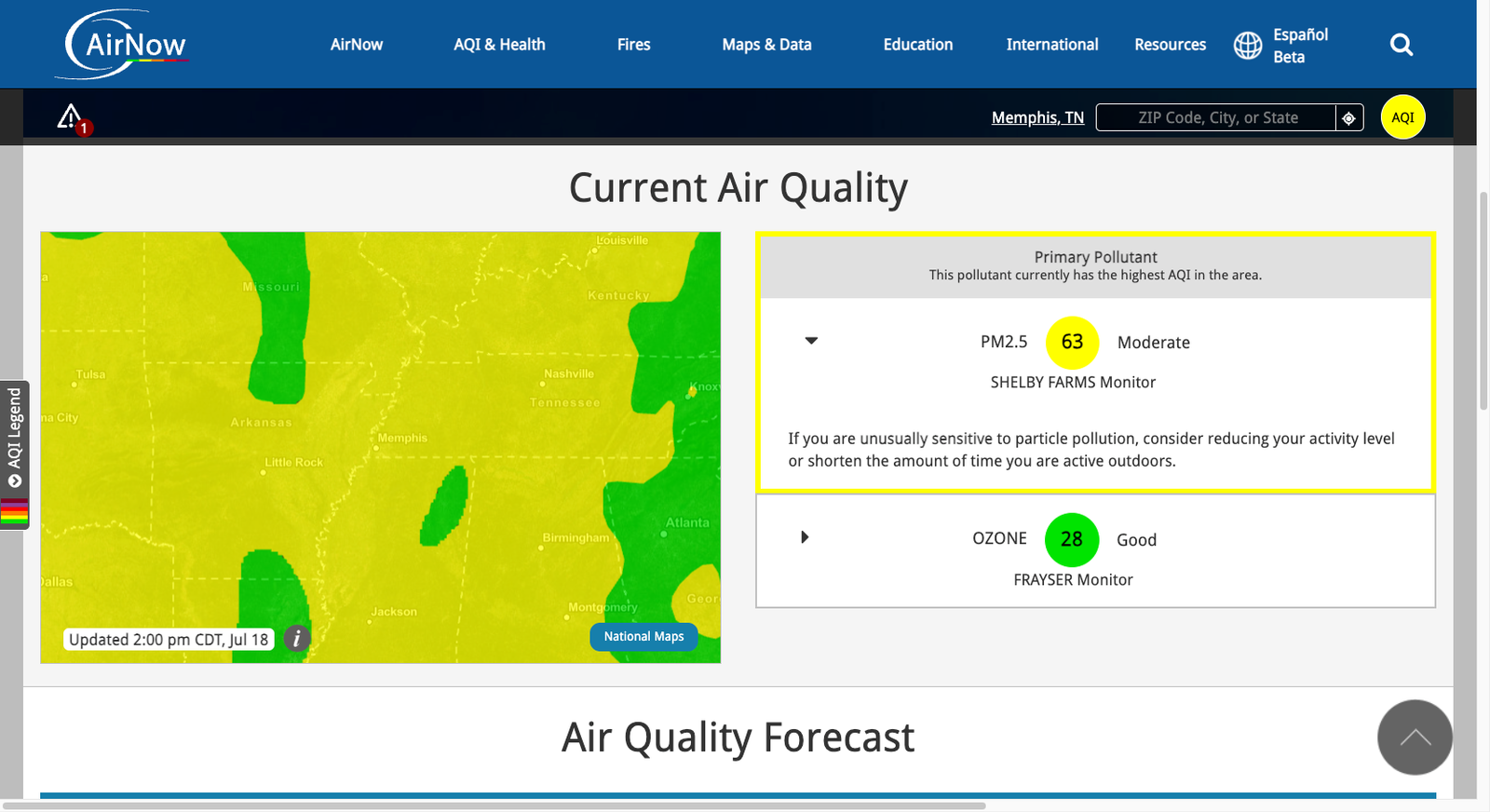
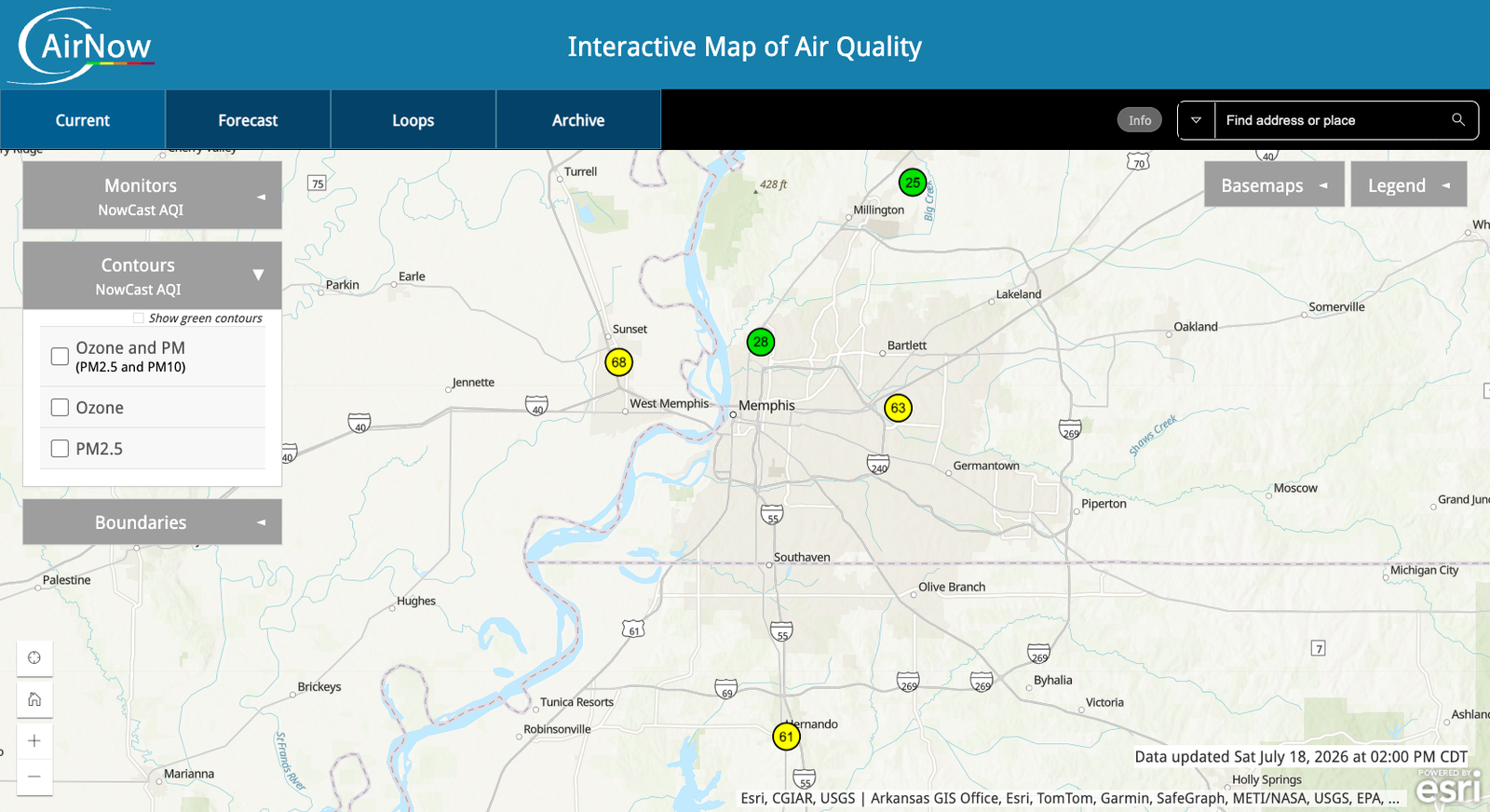
So, I started researching the air monitoring situation and how it works. I checked AirNow, the gov't's own air quality site, on July 18 - and the fine-particle reading for Memphis was attributed to a monitor in Marion, Arkansas. The ozone number came from Frayser, about 15 miles from Boxtown [1]. The data didn't show anything alarming.
But those monitors are pretty far away. South Memphis hasn't had its own official air monitor in over ten years - but it used to. I found four inactive regulatory monitoring sites in or near South Memphis, pulled off the inactive-monitor layers on EPA's AirData map [2].
Two were near TVA Allen, the power plant, and measured sulfur dioxide - a mile and four miles out from the plant, in the same area xAI sits in today. One was at West Mallory that measured lead - and one was on Hernando Road, measuring sulfur dioxide, carbon monoxide, and lead.
So, what happened to them? Why would they decommission them?
Records show that all of them went dark between 1992 and 2007. They were there because a coal plant and an oil refinery made this area worth watching. Leaded gasoline put about 200,000 tons of lead into the air every year in the early 1970s [3], and Allen burned 7,200 tons of coal a day [4].
Then lead came out of gasoline and lead emissions dropped about 99% nationally [3], so the EPA rewrote the rules in 2008 to require monitoring near lead sources that emit above a set threshold - and near certain airports - instead of everywhere [5].
But I was still confused on why they stopped using the sulfur dioxide monitors. TVA Allen burned coal until 2018. In 2011, they settled a Clean Air Act case with the EPA and agreed to retire the units by the end of 2018 - and they did [6][7].
While trying to figure out why they stopped monitoring, I came across something that was kind of mind blowing - the coal burned decades ago left something behind.
About 3 million cubic yards of ash sits in unlined pits at the TVA Allen site. It sits over the shallow "alluvial" aquifer - and below that, separated by a clay layer, is the Memphis Aquifer, which is the region's drinking water [8]. TVA's own inspector general found the agency had indications for more than ten years that toxic metals could be leaking, with arsenic in monitoring wells that were above modern drinking water standards [9]. Like I said - TVA Allen is basically across the street from xAI. I've driven over there and looked.
Anyway, the state finally ordered it removed - some sources say this started in 2021 - others 2022 - but TVA is still trucking it about 19 miles to the South Shelby Landfill, and it's expected to take eight to nine years to finish [10]. TVA's own estimate is about 120 loaded truckloads a day - roughly 240 truck trips when you count the empties heading back [11]. More on this later.
So, circling back, the monitors went dark between 1992 and 2007 - way before the coal stopped burning. So, why?
Well, as far as I can tell, the 1990 Clean Air Act Amendments set a national cap on sulfur dioxide. Congress decided how much SO2 the power sector could emit, then handed out permits - called allowances - against that number. One allowance was equal to one ton of SO2 [12].
Plants got allocations of these allowances - though not every plant got them free, newer units generally had to go buy them. At the end of the year, you had to hold one allowance for every ton you actually emitted. Emit more than you hold and the fines are severe. And the Acid Rain Program required continuous emission monitoring systems on the stacks themselves. Instruments in the flue, measuring what's actually going out, that reported hourly to EPA. So, the stack monitors enforced the program that cut the pollution that made the neighborhood monitors unnecessary.
Just as an interesting side note - if you didn't use all of your allowances - you could sell them to other power plants.
So, if one power plant cut their emissions by doing all the right things, they could then sell their allowances to others that were going over the cap - and those heavy polluters would stay in compliance.
(On another side note, this is basically the same kind of mechanism that kept Tesla afloat when it wasn't profitable. Tesla used ZEV credits under California's zero-emission vehicle rules, plus federal greenhouse gas and CAFE credits. Tesla only makes electric cars, so under the rules, it generated credits it had no use for. Automakers selling gas cars had to buy them. In 2020 alone that was $1.58 billion in credit revenue against $721 million in profit [13]. What a country!)
Anyway, the new rules worked, and SO2 came down faster and cheaper than almost anyone predicted. It's the most successful environmental program of that era, and people still point at it as the model.
And surprisingly enough, TVA Allen didn't buy its way out of cleaning up. It cut SO2 hard - from 23,882 tons in 2005 to about 7,600 by 2017 - and just sat on most of the surplus. By 2017 it was holding over 94,000 allowances it never used [14].
So, that's roughly how the monitors in South Memphis went dark. But was it a mistake?
Well, the thing is - that whole network was built for the pollution problem of the 1970s - lead, sulfur dioxide, and carbon monoxide. Fine particles - the thing that people are worried about now - didn't even become a federal standard until 1997 [15]. So even if every one of those four monitors were still running today, not one of them would tell us if xAI is polluting South Memphis.
Now, here's the part where I can finally start pointing the finger at someone fucking up.
The EPA gave the Shelby County Health Dept $411,000 for a new monitor in South Memphis back on August 1, 2024 [16]. These grants get applied for months ahead, based on air problems a community already has - nobody applies for an air monitor because a data center might show up. The concrete pad finally got poured August 14, 2025 - over a year later. This past March, the county was still filing paperwork to add the site to its official monitoring plan [17]. I've read that it was supposed to start up in May or June of this year - but I checked the public data files today and found nothing from it - so that's a failure in itself - but there's an even bigger problem with it.
The station they're building measures carbon monoxide and ozone - not fine particles or anything else that's useful for the current situation. And ozone monitoring here runs seasonally - the county plan has it running March through October, so it goes dark November through February [17].
And as it turns out, what many people believe is the biggest culprit in the air pollution fight, xAI's gas turbines, well - gas turbines put out far less direct particle pollution than coal or diesel does. That's just how the fuel works. Natural gas has essentially no ash in it [18].
That does not mean they're clean, and it does not mean they're not contributing. Turbines emit nitrogen oxides which can convert into nitrate particles - and nitrate particles count as PM2.5, which is a size category. Particles small enough that 30 of them would fit across a human hair. So there's a genuine turbine-to-particle pathway [19].
Where those particles form and where they end up - well, nobody has modeled that for this site. It can be miles away from the actual turbine when it mixes with other substances in the air. That's not me letting anyone off the hook. That's just the actual state of the evidence.
Turbine exhaust also carries very high concentrations of ultrafine particles. Those are inside PM2.5 by size, but they weigh almost nothing - so a monitor that measures particle mass can miss a huge number of them entirely. And there's no federal standard for them at all [20].
So - why allow the turbines? Well, ultrafine particles come out of nearly everything that burns fuel - diesel trucks, gasoline cars, jet engines, the refinery, and gas stoves. Traffic is the dominant urban source in most studies. And if xAI just ran straight off the power grid - that means more generation at TVA Allen, the gas plant across the street. And as I've said before, you can't just make a law for one company. Outlawing xAI's gas turbine use outright would have a domino effect across multiple industries.
The real issue is that none of the studies done have been a smoking gun because even though some detected fine particles - they can't tell you where the particles came from. Neither can a satellite. Neither can the model built on numbers xAI reported about itself.
So the four studies might all have good data. But none of them can tell you whose smokestack is adding what to the air - or if it's even coming from the smokestacks.
That's the whole problem. And it's the same problem the 2013 study I wrote about ran into - it traced cancer risk from air toxics sampled in 2008 to 2010 and found mobile sources drove 57% of it while industry drove 14% [21].
The TIME satellite work found nitrogen dioxide up about 3% on average after the turbines started, about 9% in Boxtown at the peaks, and 79% at the peaks right around the facility - but the researchers themselves said they couldn't separate xAI from the TVA gas plant next door or the traffic [22]. Remember, TVA is also running about 120 loaded truckloads a day of coal ash out of that site - and diesel exhaust makes fine particles, too. That's one more source in the mix that nobody is measuring.
So, here's where all of this leaves us.
South Memphis had monitors back when the pollution was coal smoke and leaded gas. Those problems got solved - the monitors came down. There were already air issues in this area long before xAI - that's why the money for a new station was there in the first place. Now the station still hasn't been activated two years later - and it doesn't measure either of the two things people are actually worried about.
Two things would fix that - and neither one requires anybody to admit that they did anything wrong.
The SCHD should add fine particle monitoring to the new station. That's what people are worried about, and it deserves an instrument the gov't actually accepts. When it was measured in two previous studies by outside entities - the SCHD pushed back [23].
And they should add nitrogen dioxide monitoring, too. Every combustion source out there emits NOx - the refinery, the trucks, the trains, the TVA gas plant, and xAI. NO2 alone won't tell you whose is whose. But NO2 measured next to wind direction, with the turbines' actual operating hours in hand, starts to. Right now we have none of the three.
I've said many times that this was all a city, state and county issue - but I was wrong. DID YOU HEAR THAT? I WAS WRONG.
The money for the station comes through the EPA, which Congress funds and oversees - and the health dept's own deputy director said the effect of federal policy changes on it "remains to be seen" [16]. That's the county saying that it isn't sure if the funding for the air substation will survive. We need someone in Washington pushing for the upgrades and keeping the thing open.
The EPA's Enhanced Air Quality Monitoring program has already been handing out awards for these kinds of upgrades. Rhode Island got $217,500 for enhanced continuous PM2.5 plus equipment upgrades. New Jersey got $234,000 for enhanced PM2.5. Connecticut got $202,000 for upgrades at existing sites [24].
So adding PM2.5 and NO2 to a station that already exists is an ordinary grant-sized ask, not a capital project. Other states have been getting funded for it for years.
The permits are the county's. The zoning is the city's. But the monitoring money is federal - and so is TVA, the agency that burned the coal, left the ash, and is trucking it through these neighborhoods right now.
Now, to be clear, a monitor doesn't shut anything down. But it ends the guessing. Right now xAI checks its own compliance and reports twice a year - a monitor is an outside check on that. And if the readings come in over the federal limit, the county can get designated non-attainment, which forces stricter permits and makes every new polluter offset what it adds. SELC petitioned the EPA for exactly that ruling last year and it's still pending [25]. This kind of thing takes years - but it's the only road that goes anywhere, and we're not on it.
So, what have we learned?
If you want to solve an issue - you have to do more than complain about it. You have to dig in and figure out a solution. Sometimes that means finding out you were wrong about part of it. But the goal shouldn't be being right - it should be fixing the problem.
And finally, the lead and sulfur dioxide that used to hang over this neighborhood were far worse than anything measured here today - and we didn't fix them by arguing about them. We fixed them with rules, and instruments, and somebody checking. That's what worked. It's boring, and it's slow, and it's the only thing that's ever actually cleaned up American air.